First Google AdSense check

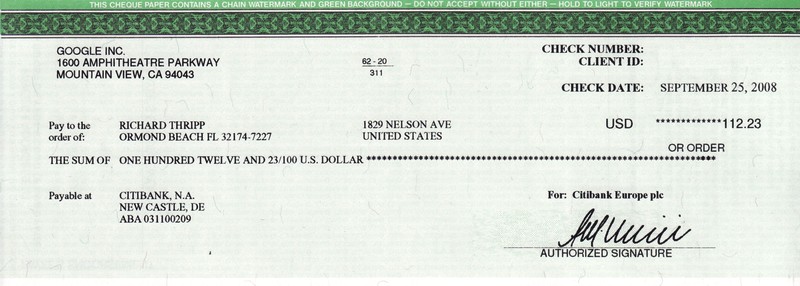
$112.23 Google AdSense check

Just got this check from Google for $112.23. I wasn’t sure if this Google ad program was real till now; perhaps they’d just take my money and ban me when I reached the $100 threshold? :xx:

I started this blog way back at the end of last year, just for my photography. I didn’t do much for a long time, often just spending lots of time fiddling with the layout and code, but in the past two months I’ve made lots of progress. I feel I can do a lot of good here, if not for others, for my own mind.

While DaytonaState.org makes the most, the balance is switching to this blog. I think it’s because I’m writing in-depth, thought-provoking articles like Digital Sharecropping, Personal Development for Photographers, and Transcending Limiting Beliefs. Not lists or tables or mash-ups or charts. No fluff. Writing that takes will work and has a real purpose. I didn’t really start doing this till two months ago, when I added personal development as my main subject alongside photography.

While $112.23 is no more than pennies an hour for all the work I’ve put in here, it’s much better than any job because I would do this for free. Most people can’t say that about their jobs.

Even though I made far more as a criminal, it’s much better to profit as an asset rather than a leech. Friends have been quick in offering to click ads for me or get others to do the same, but I’ll have none of it.

My hosting bill is paid up till 2009 March, and it has totaled $70. I also registered Thripp.com till 2018, costing $73, and thripp.net/org/us/biz/info are mine. I’m in this for the long haul. Expenses don’t really count, because I’d be paying them either way.

This month has been the best yet; I’ve taken in $61; half of what I made in the eight months before combined. Curiously days have bounced between $0 and $4 rather than being constant like last month, but it doesn’t matter.

Some people hate ads. If I was one of them, I would’ve made nothing. If this is a business, I’m lucky because most businesses lose a lot of money to start.

You can’t expect to make money if you don’t even try. Blogs are much like newspapers, which pay their printing bills and more with advertising. Now, the bills are time, effort, and less importantly, web hosting. And the message is free, rather than being a token fee of thirty-five or fifty cents.

However, if you give away the message and turn your back on advertising and turn down donations (read: don’t ask for), you can’t turn your passion into anything more than a hobby.

Unrelated: the URL for this post has 666 in it because that’s the post ID. It’s just a counter. I think it’s cool to have it at the end of URLs. I’ve actually made only 530 posts and pages, but the other numbers have been lost to test posts and drafts. Think of it just as an arbitrary number to uniquely identify each of my articles.

Also: this post is evil. :evil:

Digital Sharecropping

Before 1994, the Internet was basically unknown. It was just a tool for professors and researchers to connect with their peers. All websites had to be non-profit.

In 1994, the National Science Foundation took away these restrictions. Anyone could register a domain name and start a website, even to sell stuff. Pepsi.com was one of the first, but at the time it seemed a pointless gimmick.

Flash forward to 2008. In the past five years, power has become consolidated between a few major websites, despite the flat nature of the Internet. Google, Yahoo, Facebook, MySpace, and eBay are the major players. These corporations control billions of dollars in capital, yet with the exception of eBay, provide free services. How does this happen?

MySpace

The way it happens is through advertising. Much like how newspapers make money from the classifieds or how the local Pennysaver is completely free despite rising print costs, websites make money from selling ad-space. With technology like HTTP cookies and click-counting, advertisers can pay only when viewers click their ads, or even only when they make a sale. If you think no one buys anything online, take a look at this.

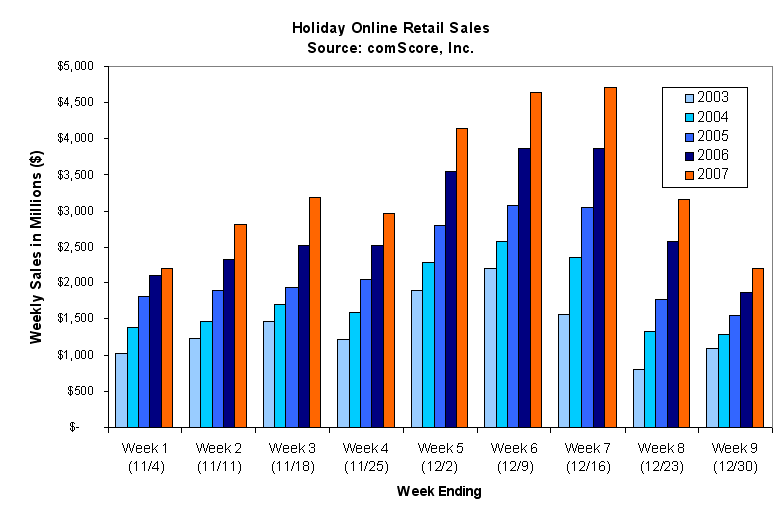
2007 Christmas online sales

That’s a graph of how much stuff people bought in the 2007 Christmas season. At the peak, for the week ending 2007-12-16, sales totaled nearly 5 billion dollars. Thanks to comscore.com for the stats.

As you can see, people have no aversion to buying things on the web. And unlike with newspapers, websites have far lower overhead. Each visitor costs less than a hundreth of a cent each, while advertisers may be willing to pay in dollars for clicks or sales.

The reason social networks have become so large and wealthy is because most people contribute to them for social benefits, while all the economic benefits go to the operators of the network. Many people may only generate a few dollars in revenue, but with millions of people it adds up. Also, people will join even a hard to use and poorly designed website if all their friends are on it, so the rich get richer.

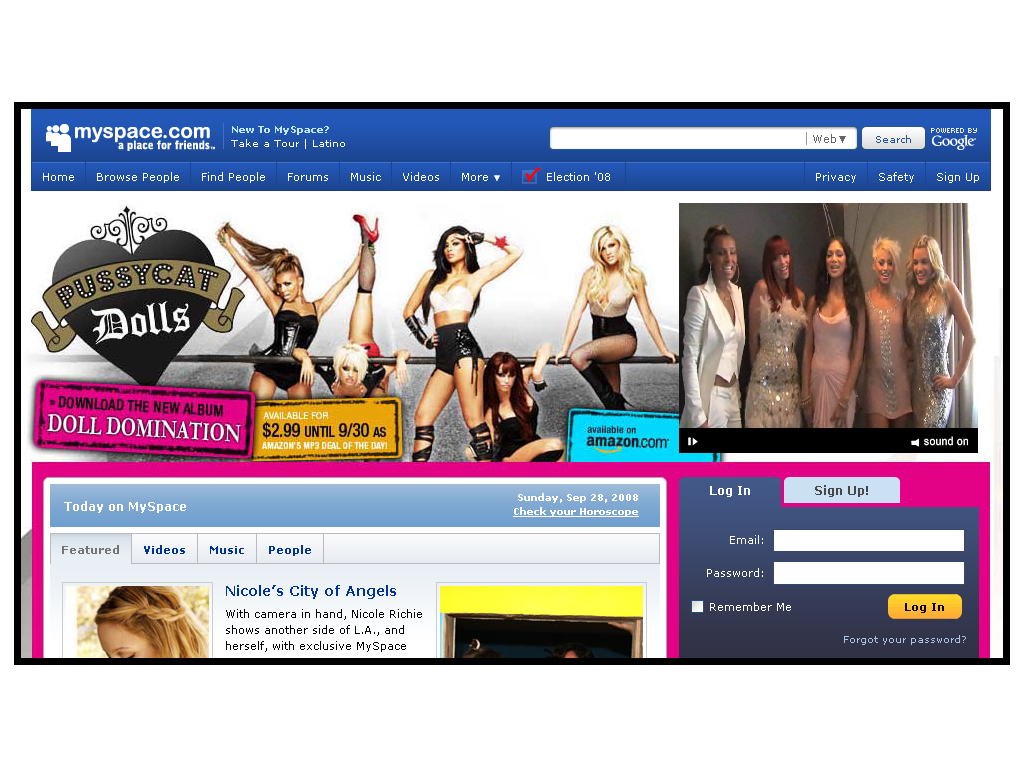
MySpace has ads all over the place; their home page is one big ad as you can see, and when you log in it gets even worse. People use it anyway because so many people are already using it, not because of it has intrinsic value.

When you’re contributing to MySpace or Facebook or any other network you don’t control, you’re a sharecropper. But what is a sharecropper? This is a good definition.

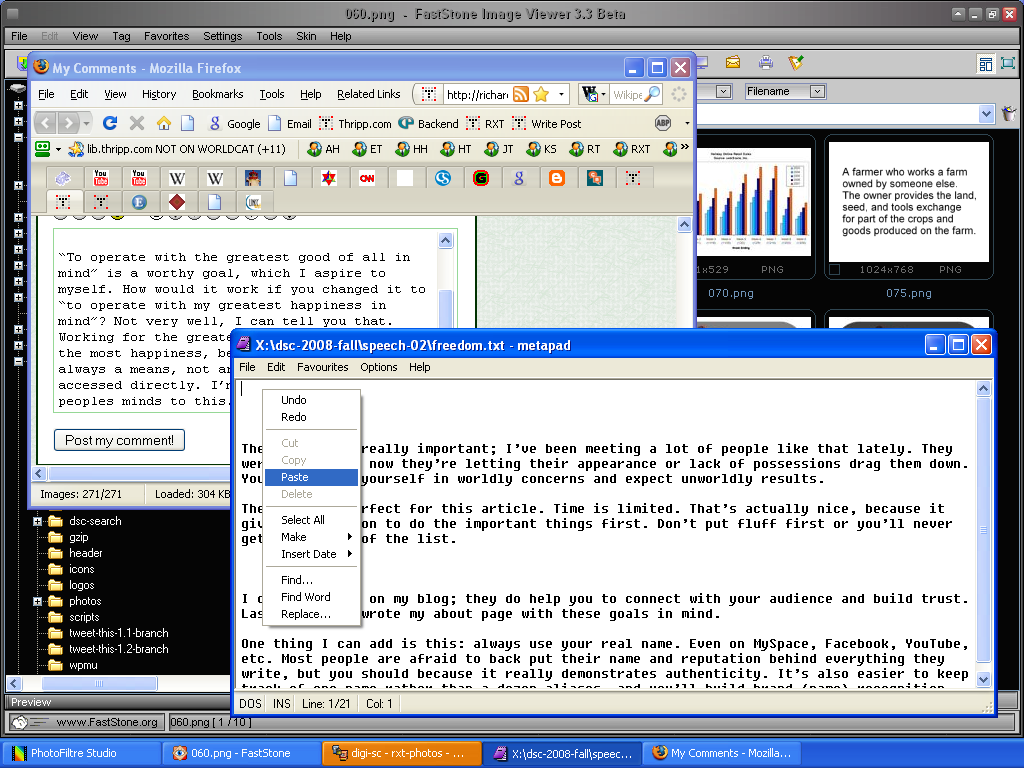
“A farmer who works a farm owned by someone else. The owner provides the land, seed, and tools exchange for part of the crops and goods produced on the farm.”

Sharecropping on the Internet is even worse, because you don’t even get a portion of the fruits of your labor. You give up not only the means of production, but also all revenue earned and the information itself.

My Dad was banned from YouTube because he’d get into all sorts of political arguments with people there. Not only do they delete all your videos, but every comment you’ve ever made disappears from the site upon your removal. That’s what happens when you’re a sharecropper, and the owners are free to do that because it’s their website. If my Dad didn’t keep backups of everything he writes and posts, he would’ve lost it all.

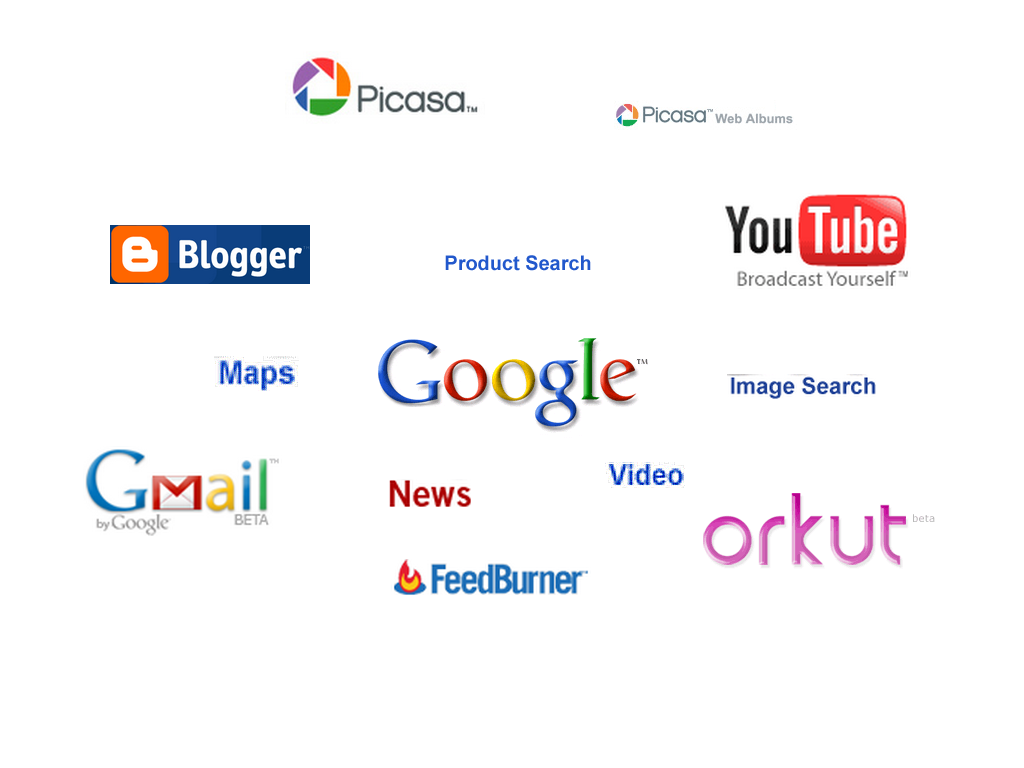
We’re all sharecroppers for Google. Here’s just a few things they own:

Google's stuff

It’s hard to keep track of all these services, so they have this nice umbrella called the Google Account:

The Google account

Everything runs nicely for a while. You have all your maps, your credit card data (Google Checkout), your calendars, your emails, your search history, your contacts, your pictures, your blog posts, and more on Google’s servers. Then they decide they don’t like you anymore:

No more Google for you

Thanks for being a good sharecropper, we know longer need you. Good-bye. This is the message my Dad got when you tried to log into his YouTube account. Now, YouTube uses Google Accounts, so if he was banned now, his emails might vanish too.

Obviously, Google can’t go around banning all it’s members if they want success, but we’ve given them a lot of power. I don’t know about you, but I don’t like to give up my power, even in the name of convenience.

If you think it can’t happen, take a look at this: When Google Owns You. This guy was locked out of his email, documents, photos, and instant messaging, because Google shut down his entire account. He got it back eventually, but the real problem is that we’ve all given up our power.

Though our computers are more powerful than ever, we’ve become increasingly dependent on Other Peoples Computers. We let Google or Yahoo hold our email so we can get to it from anywhere. We put our pictures on Flickr or Snapfish or Picasa Web Albums so our family can see them from anywhere in the world. But they’re not on our computer, so Flickr or Snapfish or Google can take them down at any time.

Should the government force web corporations to share their profits or hand the means of production over to the people? I say no, because that is socialism and it would discourage new innovation. Like it or not, it’s hard to create infrastructures like Google or MySpace, which allow millions of people to share information for free.

you.com not myspace.com/you

The base-level infrastructure will always be the Internet and sites like you.com, not myspace.com/you. Don’t put much effort into your site on MySpace; start your own site.

Breaking the chains requires you to have a computer on all the time and a registered domain name. You also need software on the web server to manage your photos, text, video, or other content. These are good to start with:

Content management software

The best way to get a web server, when you’re starting out, is to rent one. You do this through what is called a web host, which costs about $10 a month. You also register your domain name through a registrar, just like MySpace and Facebook do. You have to pay $10 per year for that.

I use GoDaddy.com as my domain registrar and SYNhosting.com as my host. My whole blog and photo gallery is run by WordPress and other open-source modules, and it’s no more work than using MySpace, besides a large up-front investment of time and effort. I’m not sharecropping, because I can easily switch without losing my domain name if I get tired of either of these companies. If you’re a sharecropper and you switch landlords, forget about keeping the same URL.

Back up stuff

If you can’t do the above, there is an easy, immediate step you can safeguard yourself with. Back up your data. Whenever you write anything on a site you don’t own, copy it to a text or Microsoft Word file on your computer.

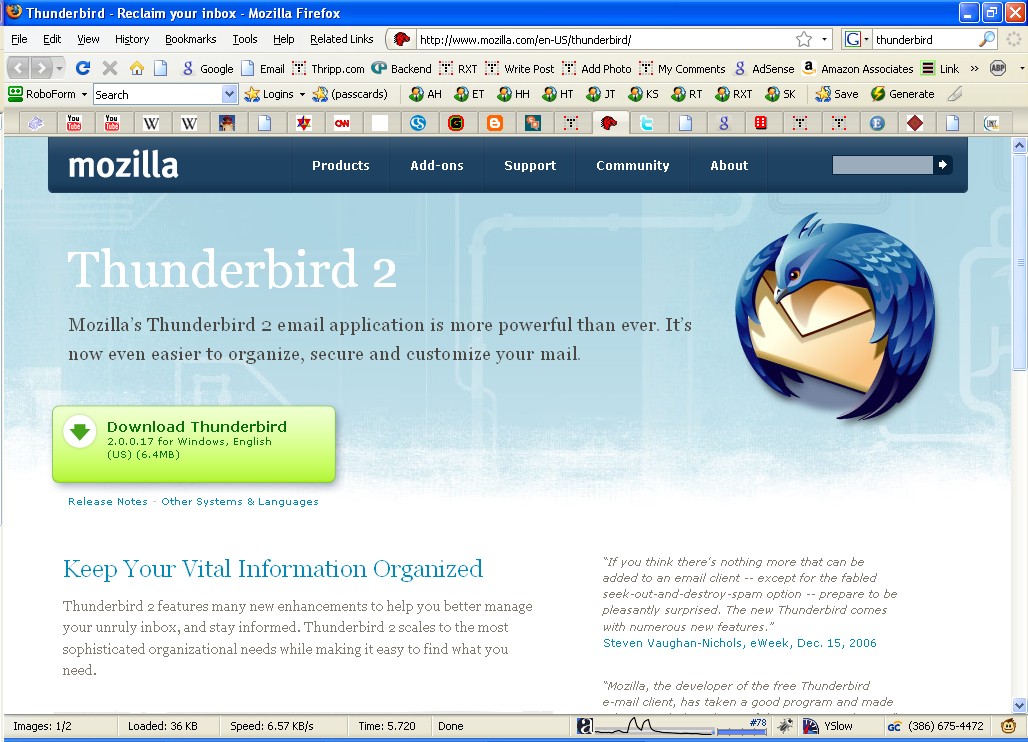
Thunderbird

If you use Gmail (owned by Google), use Mozilla Thunderbird to keep a duplicate copy of your email on your computer. Even if Google steals your emails, you’ll still have them on your machine. You can also use Microsoft Outlook Express with your Gmail account, and they even have tutorials on how to do it.

Flash drives

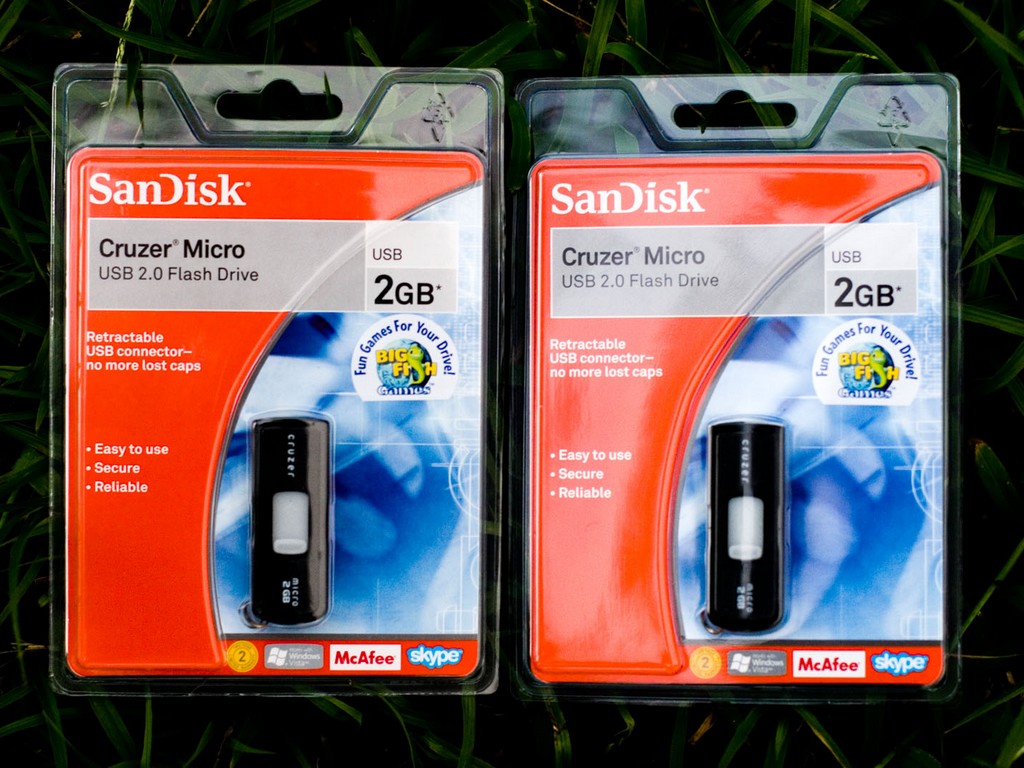
Instead of giving control of your documents over to Google, keep them on a flash drive. You can still get to them anywhere, because you can carry a flash drive with you all the time. Even better, you don’t need Internet access to get to your stuff. Your files are right here, not on some far-off server where they can be stolen or deleted on a whim. Make a backup copy on your computer at home whenever you change stuff, and you’ll be fine.

Moving away from your landlords is hard, but think of it this way: even if you get one-tenth the visitors to your new website and it looks like garbage, it’s still ten times better than continuing as a fruitless sharecropper. You can ever put ads on your site. I made $60 through Google’s AdSense program this month, and while you could say that I’m still sharecropping because I’m beholden to them, if they kick me out I can easily switch to Yahoo’s ad offering or I can sell ad space directly. If you’re on MySpace, you have no such options. There are plenty of ads, sure, but you get nothing for them, even if you become insanely famous.

You can’t be free as a sharecropper.

Personal Development for Photographers

Personal development is universal, so it includes photographers. A lot of photographers are stuck in a lot of ways. They take too many photos, entangle their intuition with technicalities, refuse to rise above spectatorship, or abandon their creativity for the comfort of rigid rules. I did all these for some time, so I want to help others rise above these limitations.

Too many photos

Most photographers live with a scarcity mindset. This means they believe they must be taking photos every moment, in case they miss the ‘perfect’ moment. There is only one ‘perfect’ moment (scarcity), so it’s important not to miss it.

I can tell you this because I used to be one of these people, and I meet fellow photographers who are stuck in the same mindset all the time.

Back when I was in photography class, I met a lady who took 1500 pictures of a wedding in a span of two hours. I’ve been fortunate enough to avoid weddings, but I can tell you now that I would be taking 1500 photos, even if the wedding was all day. I might take 1000, but I can assure you they’d mostly be duplicates. I’d be deleting the worst and keeping the best on the spot, and by the end of the day I’d be down to 200 photos. Good photos.

What was even more unfortunate about this girl was that she made no effort to cull her work. “Culling” means picking out the best. I slaved for hours over my portfolio, narrowing down hundreds of photos to my best 30. Some good photos didn’t make it because they just didn’t fit in with the other ones. I spent more time ordering them by color / concept than choosing, because the order is far more important than the content.

It’s alright if you take 1500 photos for a wedding, even if you keep them. But when you do that, know that you’re going to bore the heck out of people by showing them all, and you’re going to put in many hours weeding out the crud.

If you don’t weed out the weeds, you’ve got nothing. All people will see is a bunch of weeds and they’ll walk away before you get to the good stuff.

The abundance mindset

Ironically it’s the abundance mindset that leads you to taking fewer pictures. Your work becomes much more interesting too, because you’ll produce a few great pieces instead of dozens of mediocre ones. Oftentimes you’ll actually take more photos, but they’ll be focused. Instead of doing 50 shots of every plant in the garden, do 200 of a rose from every possible perspective. Learn from it, pick out the best one (I do mean one), and discard (hide) the rest.

For photographers, the abundance mindset says that you’ll have so many great photo opportunities, it’s alright not to pursue them all. It’s even alright to ignore a beautiful sunset just to focus your camera on the light on the trees. If you’re in the scarcity mindset, you’re dead-set on the sunset because you’re afraid you’ll never see one like it again. But really, what you get is the same dull photo that everyone else has already taken, while you could’ve been using the sunset for something better, like portraits of passersby (the lighting is great), refractions off a leaf, the clouds behind you, or the light and shadows around you.

The abundance mindset lets you focus on one thing while ignoring everything else. If the space shuttle is launching right in front of you, take pictures of all the people taking pictures instead of the shuttle itself. Take a photo of the launch site ten seconds after lift-off. No one is doing that.

Believing in abundance lets you go for a walk in a “boring” neighborhood yet bring home a picture like this:

Basketball Hoop

Whatever you think is ‘boring’ isn’t so boring after all. I hear photographers complain all the time that there is nothing interesting around them, but really they aren’t even trying.

If you’re not willing to look harder for subjects (still life or people) in your current environment, go somewhere else. Go to different places, talk to different people, take different pictures. Go on vacation. Become a nomad. It isn’t that hard, and if you believe it is you’re only limiting yourself.

Hands-off photography

Other photographers believe they should be hands-off. “Just take pictures, don’t interfere with people or nature.” Photograph what you see. Really, what these people are doing is trying to absolve themselves from effort. They’re scared of directing people on how to pose, so they’d prefer just to leave it up to their models.

But the fact is, your models don’t know what to do. As the photographer, it’s YOUR job to tell them what to do. The word “photography” implies mere observation, but it’s so much more than that. As a photographer, you create the scene. Even if you don’t have to tear down buildings or dirty your hands with makeup, you do have to direct people and the environment. Even if you don’t touch anything, you’re still directing the scene through composition. You can get far away and use a telephoto lens, or close-up with a wide-angle lens, and you’ll get two very different photos of the same subject under the same light. You can take photos at eye level, or you can lay in the dirt and point your camera up. You can include things, you can exclude things, you can manipulate light, all without entering Photoshop.

Any wedding actually involves three people: a man, a woman, and a photographer. It’s really a marriage of three. You have to tell the couple how to pose, where to stand, what to wear; perhaps even what day to plan their wedding for or where to hold it. If it’s a Florida summer, retreat indoors. People like sunshine, but cloudy days make for better lighting. These are all going to be important if you want to create good memories, because memories are about emotion, not facts or record-keeping.

Embracing flexibility

I used to have this unstoppable urge to stretch the histogram across the gamut from light to dark in every photo. This means I’d edit contrast fairly aggressively, and then whatever was left over I’d leave up to the computer’s “Auto Contrast” tool. Every picture should touch (0,0,0) (pure black) and (255,255,255) (pure white) in at least one pixel.

This worked fairly well for a while. I did cool stuff like Raindrops and Sky’s Camouflage. Even Two of Us Against the World, which most people think of as soft-toned, is stretched across the whole gamut.

Cherry Tomatoes

This became very limiting, though. When I got to pictures like Cherry Tomatoes (above), it couldn’t look good with the tomatoes going to black, but that’s the only decision that would keep in step with my beliefs. I compromised on that one; the darkest tone is about (110,20,0), with 90% of the colors being in the upper fourth of the luminance scale. This way, I could continue criticizing other photographers (in my mind) whenever I’d see anything with dull contrast.

It turns out, dull contrast is often good. Going back to the basketball hoop photo, if I would’ve done what I used to do, the sky would be right up against pure white. But with subdued colors, it’s much more appealing and interesting (the sky doesn’t go past 230/255).

What this means is: be flexible. No rules are hard and fast, and everything can look good in different occasions. Don’t use rules or formulas to determine that; use your eyes and your innate sense of beauty. Which brings us to…

Stop making sense

Psychologists say women like mental pictures, men like real pictures. This (supposibly) is because men are left-brained while women are right-brained. This means that “visual learners” fall into the left-brained category.

For 90% of photographers this is false. Unless you’re in technical or journalistic photography, you’re going to be dealing with the right-brain (emotions) most of the time. This falls under of the umbrella of artistic photography—most people just call this photography, because it’s what the medium has become associated with.

But even if you’re a photo-journalist, a big portion of your time (if you’re good) will be about emphasizing emotion. If there’s no emotion, create it. You can ‘cheat’ without editing the image. Use a different angle, or convince the people in the scene to act differently, consciously or subconsciously.

The purpose of my photographs is to create emotions within my audience. It doesn’t matter if the pictures are true. It doesn’t matter if I tore up weeds or if I used a medicine dropper to add droplets to a leaf. It doesn’t matter if I completely Photoshopped the colors so they look nothing like the actual scene. It doesn’t even matter if the scene is a physical impossibility.

What matters is creating feelings within my viewers, be it affection, love, awe, repulsion, emptiness, bravery, coziness, timelessness, intrigue, courage, freedom, oneness, or inspiration. While I may not identify it as such, each photo has one main emotion behind it, and sometimes a second one, which either complements the first or contrasts with it in an ironic way. This isn’t something you can purposely manufacture; I never even thought about it this way till I wrote this paragraph. It’s just there.

This means that photography falls on the right side of the brain. Emotions are more important than logic.

Pink and Purple Sunset 3

The sunset above doesn’t exist. The sky had the same colors and appearance, but it was much less brilliant. I emphasized the colors in Photoshop. You might be able to do the same thing with a polarizing filter or settings in-camera, but you’d always be creating something better than reality.

Most people, seeing this photo, either revise their model of reality to include the existence of sunsets like this (90%), or ask me if I manipulated the photo (10%). The last group I tell yes, so they can appreciate this sunset while knowing it isn’t ‘real’ (whatever that means).

If you act ashamed that you edit your photos a lot, your viewers will assume it’s a shameful thing. Don’t do that. I removed trees, houses, and streetlights in the sunset above, not because I wanted to, but because I had to. I’d always prefer just to take a new photo than to spot-edit an old photo, but this one was worth it.

Most of the time I do editing across the whole photo, like contrast, brightness, and color temperature. I’ll do localized dodging and burning (brightening and darkening), but I try to avoid spot editing, not for ethical concerns, but because I’m lazy. Spot editing is hard, and if I have to spot-edit a photo to take out power lines or trees, I may as well start over with a new photo.

Be insanely interesting

This picture makes no sense:

Night of Darkness

People love this when they see it, and even more so when I give out print copies. They’ll try to interpret all kinds of meanings into a solid black image, and just discussing it raises their personal awareness. Obviously it’s a picture of nothing (I left the lens cap on) but because I’ve gone through the effort (and possibly cost) of printing it, titling it (The Night of Eternal and Unrelenting Darkness), and giving it to someone, it must have meaning.

I’m actually having 100 printed out (I get them through thievery so it’s no big deal), one for each of my students in calculus and biology, and I bet it will be my most popular (at least most talked about) photo. The reason is that it’s insanely interesting. Nobody else does stuff like this (much less handing them out). If I posted to Facebook or deviantART or YouTube, it would probably be removed as pointless ‘spam’, merely because such originality scares the deletionists.

To be insanely interesting, you should create something from nothing. If everyone did this, it wouldn’t be interesting. Most people are very uncomfortable with this. They want to create something from something. This is because most people have a subconscious desire to be directed / told what to do. Personal development is all about flipping that on its head.

Being overly technical

What happens to a lot of students when they get into photography school? They start worrying about things like the golden triangle, film speed, the zone system, apertures, focal length, vignetting, the rule of thirds, sharpness, filters, white balance, color temperature, optical distortion, color calibration, sensor size, chromatic and spherical aberration, file formats, resolution, signal-to-noise ratio, refraction, demosaicing. The beautiful photographs on their walls are replaced by crazy formulas like (1 / f) = (n – 1) * ( (1 / R1) – (1 / R2) + ( ( (n – 1) * d) / (n * R1 * R2 ) ). They went to college because they had a talent for artistic photographs, but that talent totally disappears when they get there. They fail miserably. Grades are irrelevant; you’re failing with A’s if you’ve lost your heart.

Why does this happen? Because people naturally want to replace personal responsibility with assignments and directions. Instead of creating beautiful photographs, you create photographs that are beautiful according to other people, because you want to be told what to do. That’s why you went to school to begin with. No one forced you. Plenty of great photographers have never set foot in a school of photography.

I remember when the colors on my computer monitor started drifting, and my edits wouldn’t turn out right in any prints. They’d be close, but not perfect, and I couldn’t get the thing calibrated by eye because my eyes aren’t good enough. I took a whole month off searching for a cheap colorimeter and a dual-head video card to use with my new LCD monitor (which, incidentally, is no good for photo editing; I keep all editing to my bulky CRT). I did find one eventually, but I would’ve been better off working on new photos too, even if I had to go back over and re-edit them. When you get too caught up in technicalities, you produce no art. Technicality is all about perfection, but if you make perfection the goal, you’ll never get anywhere. You have to balance analysis with creativity.

Overly technical people get caught up in the things that ‘should’ look beautiful but simply don’t. Take a look at this rose:

Simplicity

Doesn’t it look nice, sublimely colorful, etc.? If a pink rose is pretty, an even pinker rose must be prettier, right? In fact, following the technical mindset to the extreme, beauty is proportional to color saturation. So this rose must be ten times more beautiful:

Simplicity overkill

Of course, it’s terribly ugly. A flower doesn’t become more beautiful when you dye its petals—in fact, it loses its beauty post-haste. But you’ll see stuff like the above in photographers’ portfolios. Usually, they’re either really new to photography, or they’ve been doing it for a long time but stagnating in technicalities.

The proper response to analytical photography is not analytical photography with intuition and creativity tacked on. It’s creatively intuitive photograph, tempered by technical analysis. That means that yes, it’s alright to purposely put your subject one-third into the frame (I do it all the time), but just don’t become too extreme regarding technicalities. When you break the rules, don’t even think about it. They’re not rules anyway.

Not being technical enough

You do have to be technical to a certain extent. You can’t leave everything up to chance, or put all your faith in your “eye” without learning a certain amount of technical concepts (exposure, f-stops, zooming, composition, shutter speed, grain, etc.). A great photo is no good badly exposed and printed.

Particularly in film photography, there is a lot of technical grunt work you must deal with by hand. You don’t want to use any old developer or fixer, and you should use a timer, a timing chart, measure the temperature of your chemicals, etc., because if you mess things up, you could end up with nothing, especially if any light gets to your negatives before you develop the latent images. Once you’re done with this process, enlarging the images isn’t so dangerous, but light-sensitive paper is still expensive, so a mistake might cost you 70 cents.

I prefer to just stick with digital photography. You have as much control in film photography, but you don’t have an “undo” button, and I can’t get by without that (yet). It’s like writing in pencil vs. writing in pen. Except digital cameras are a bit better than pencils.

Photographers vs. gear collectors

It’s okay to collect cameras, lenses, gadgets, and relics. But only if you’re going to use them to advance your photography hobby. If you’re not, be sure they’re really cheap, because a bunch of lenses do nothing for you if you can’t find the shutter button.

A lot of self-dubbed photographers don’t take pictures so much as they collect picture-taking gadgets. These people think about becoming real photographers occasionally, but then they get stuck in self-doubt.

These are the types of people who will put off photography for years waiting for the technology to get better. Things are getting cheaper all the time; that doesn’t mean you should stay out of digital photography forever. Buy a camera now and take a big ‘loss’ in a few years. It isn’t really a loss anyway, because nothing that lets you work on your art is a loss.

Also, these people will look back at what they did in the past with a cheap camera, wishing they could retro-actively change it to an expensive camera. You can’t go back and do that, and even if you could, you can’t improve by imitating your past work (tell that to Ketchup 2 and Ketchup 3).

Don’t collect gear. Use gear to take photos. Whatever camera you have now is good enough to do something good with. You just need some creativity, not more stuff.

Keep on snapping.

Transcending Limiting Beliefs

It’s a very scary thing when someone openly disproves your limiting beliefs. If you have empowering beliefs, being disproven is a triumph rather than an attack, because you’ve been given the easy opportunity to fine-tune your belief system, which can only lead to improving your self and your model of the world. But if your mind is holding you back, you’re highly afraid of breaking the chains. The three major reasons for this are:

1. If you’re disproven now, whose to say that you won’t be disproven again? If you switch from Catholicism to Protestantism, couldn’t what you really want be Unitarianism? If you disconnect yourself from your heart and intuition, you have no reason to ever change or grow. Depending on where you are in life, that could be much more comfortable than change.

2. Changing your beliefs invalidates your past. If you spend all your life buying groceries at the normal price, and then a spendthrift tips you off that you could easily pay half the price with judicious acquisition and use of coupons, what does that say about all the groceries you’ve already bought? If you accept your new couponing beliefs fully, you’re acknowledging that your previous shopping beliefs cost you thousands upon thousands of dollars. It could be much more comforting to simply block coupons from your reality.

3. Changing beliefs may conflict with your actions. If you don’t want to do what you’re doing, then you must either stop doing it, develop the want, or be a coward by doing what you don’t want. If you’re a lawyer now, and you find you can’t win a case without dishonesty, but you want to be honest, then you have to be a hypocrite, an unsuccessful lawyer, or an unemployed person. But if you continue believing dishonesty is okay, you don’t have to change at all. Only a change in your beliefs requires a change in your actions.

Defending a limiting belief

You can always pick out a person who has caged himself with limiting beliefs, because he reacts defensively when your actions or successes contradict his model of reality. If you’re an astronaut, and you tell a member of the Flat Earth Society that our planet is round, what can he do?

1. Ignore you. Pretend you don’t exist.
2. Call you a liar. You saw that the Earth is flat, but you just like to deceive others.
3. React defensively. The “are you calling me a liar?” response. Or maybe “this is none of your business; I don’t have to tell you anything!” Anyone who says this is subconsciously limiting himself. Accepting that hurts.
4. Accept your belief, but attribute it to confusion, misunderstanding or confirmation bias. You want to believe the Earth is ball-shaped. Subconsciously, you bend the truth to fit this desire.
5. Call you a lunatic. This is a more extreme version of the above. The Earth is flat, but you had a hallucination and saw it as round. Maybe you were on drugs?
6. Become a hypocrite. Acknowledge the photos of the round Earth, but continue to attend Flat Earth Society meetings and give out booklets. Believe in both a flat Earth and a round Earth, but flip between the two as convenient.
7. Extend the system to accommodate the new belief while supporting the old belief, even though they are inherently incompatible. “Backward compatibility,” if you will. The old belief is true in every instance except ____. Same as: the laws of physics apply to everyone except the Apollo crew.

Obviously, all of these are sub-optimal solutions. Fortunately, they give a clear indication of limiting beliefs. You can use this model to identify weak points in yourself and others.

For example, no one can tell me I’m not serious about photography or personal development, or that I don’t enjoy either of them. If someone says “you don’t look like you want to do this,” I’d have a good laugh about it, because it doesn’t shake my belief system at all. But if I really wasn’t enjoying photography, yet I was stuck in a college education + career of it, I might do something different. Instead of coming to terms with not being where I want, I’d deny it. If I did this, I’d probably respond with the “this is none of your business” tirade.

Really, there’s no reason to say “this is none of your business.” There’s no reason to prove the other person wrong either. Unlike a cinder block, words can only hurt you if you let them hurt you. Once you believe your emotions are the domain of others, you give up sovereignty over your life. You become a drone and a slave all at once.

Another example: “bad stuff is happening, so I should be upset” is quite a limiting belief. You’re only upset because you want to be upset. No matter what happens to you, you could remain happy if you consciously chose to, rather than being ruled by your subordinate subconscious.

Once you decouple your emotions from your circumstances, your mind becomes much clearer. While your environment continues to toss you about like the waves of the sea, you’re now floating smoothly above the water, like Jesus. Rather than changing your focus every day as friends and advertisers recommend, you may stay focused on the same project for weeks or months. You won’t multitask at all, and you’ll work much more efficiently because of it. I did this when I was coding the software for my public library, and although my focus has shifted to writing more articles like this rather than opening a public library, it’s only because I’ve identified this as more important. Nobody else can or should do that for me.

Once you separate your mind from your environment, you’ll gain determination like no other. Your friends will be envious. To help you, they’ll try to get you back on the track of limiting beliefs. They’ll tell you that you’re “obsessed.” Perhaps you even have ADD or ADHD. You should just be “normal.” It isn’t normal to start your own business, or to spend hours writing / composing / photography, or to not want a normal job, or to not see the value of college. Perhaps some Ritalin will help you?

I’d prefer determination any day.

Identifying limiting beliefs

“Trying is the first step towards failing.”

Homer Simpson

If “limiting belief” isn’t solid enough for you, reword it as “policy of defeatism.” The dictionary tells me that defeatism is the “acceptance of defeat without struggle.” That’s exactly what a limiting belief is. It makes you give up before you start.

Theoretically, this would be beneficial. If you try something and fail completely, wouldn’t it have been better to not have tried at all?

The problems with this are twofold: you can’t know if you’ll fail until you try, and you gain lots of experience from failure. Failure is good. I failed dozens of times in successfully labeling my photographic prints en masse, before I came up with the current laser printing method. I failed three times in naming this site while encountering logistical difficulties in fulfilling my dream. It was richardxthripp.com, then richardxthripp.richardxthripp.com, then richardxthripp.com/richardxthripp, and now richardxthripp.thripp.com, and rxthripp.com in print. When I started out, Thripp.com wasn’t even available because someone else had taken it. For a long time I thought I’d be at richardxthripp.richardxthripp.com forever, so after developing my laser printing method for labeling my 4×6 prints, I etched that address on the back of thousands of photos. I still haven’t finished giving them all out.

It took me years to conquer library science by coming up with a solid, consistent, effort-free way to assign file names to my photos. The way I do it is inconsistent with everything else I’ve read, because it completely defies logic to name your computer files arbitrarily, rather than with the subjects or people in them. So instead of flowers-and-sunshine-09-20-2008-0022.jpg, I have 20080920-132509rxt.jpg. It works better because I automate it, saving me lots of time. The only way to learn this was from repeated failures with logical taxonomy. What I really needed was illogical taxonomy, but I couldn’t have known that sans failure. I gave up time zones and Western date formatting in the process, two beliefs which seem very rational at first, but are in fact insanely limiting.

What is a limiting belief? Anything that includes “can’t” or “never” is suspect. Absolutes are always to be suspected. If you say that climbing a wall is absolutely impossible, that just means you’ve given up on climbing over it. You can still tunnel under it, walk around it, or buy an airplane and fly over it.

Before you can successfully identify limiting beliefs, you have to do two things: stop envisioning beliefs as fixed points, and stop believing that your beliefs define you. When you disconnect your ego from your beliefs, you can stop defining your persona in worldly terms, and start defining it in universal terms, such as service to humanity, justice, truth, love, etc.

I hear this one a lot: “I can’t do ____ because I don’t have the time.” I used to use it myself. The thing is, you have plenty of time. You have so much time you don’t know what to do with it all. I found plenty of time to write this article, even though I ‘should’ be studying or doing something ‘real.’ If you don’t have the time to do something, that means that thing isn’t important to you. We all have a list of priorities in our head built around a 60-hour day, and the stuff that gets done is (hopefully) at the top of the list. Only the stuff that can all fit in 24 hours. If you start at the bottom of the list, you’ll never get to the important stuff. Do the important stuff first, and you’ll find you have plenty of time—but no time for frivolous action. If you’ve fully optimized your time to the limit, you can move mountains in minutes. I’m nowhere near that, but the optimization process is more fun than the goal.

Limiting vs. empowering beliefs

This is a huge limiting belief millions of investors have:

“If you’re losing money in the stock market, don’t pull out. Your stocks will eventually go back up. If you pull out now, you’ll take a loss, but if you stick with it, you haven’t actually lost anything.”

Isn’t this absurd? It’s a hugely limiting belief. A loss is a loss; there are not two ways about it. If you’re personally developed, your losses become opportunities because you learn (and thus gain) from them, but that doesn’t change the fact that loss was the seed. Don’t gamblers have the same belief?

“I’ve lost my car and $8000 at the casino, but that’s alright. This means my luck is about to turn around and I’ll soon gain everything back.”

Of course, it doesn’t happen. If it does, the gambler thinks he’s on a “winning streak.” He continues gambling, soon losing it all again and far more. Once he starts on his chain of losses, he refuses to believe that he’s lost anything, until he has nothing left to gamble. He’s left with a rude awakening, thousands of lost dollars, and possibly a mountain of debt.

On the surface, “my luck is about to turn around” seems like an empowering belief, not a limiting one. Any belief rooted in success seems empowering, but in fact it has to be real, too. Saying “Tomorrow, I will succeed in writing fifty articles as in-depth and helpful as this one” could motivate me, but it would be short-lived because it’s impossible at my current skill level. It might not even be humanly possible (but be careful with that one). Believing I’ll write one good piece tomorrow is much more enabling.

The downfall of gamblers and investors stems from a shared limiting belief: “what goes down must come up.” Anything or anyone can go down and stay down. When you drop a brick from a tall building, it goes down, but it will never come back up on it’s own accord. When you burn down a man’s house and steal his car, he can return to material prosperity, but that doesn’t mean he “must.” A more true belief is “what goes up must come down.” That’s not a limiting belief, because it does nothing to limit you. The problem is that it is easily interpreted as the false, limiting belief, “any success will eventually be met with equal loss or failure.” You could justify this limiting belief as in “we all die,” but just because you die doesn’t mean you failed at life. If you believe that, change it to the belief that you’ve succeeded and that everyone else who dies has succeeded with you. As long as they loved living, it’s true, even if they didn’t aspire to benefit all humanity.

The profit police and the zero-sum game

Five years ago I had an aversion to advertising and profit in general. Money is evil, making money is tacky, look how annoying advertising is, etc. We get annoying telemarketing calls all the time. Wouldn’t it be better if the government banned all forms of advertising and self-promotion? Then the world would be fair.

I was stuck in the zero-sum mindset, which means that every gain must result in an equal and opposite loss. When you gain possessions, other people lose possessions. When you eat dinner, you’re making other people starve. Talk about a hugely limiting belief!

Teenagers and twenty-somethings are moochers in general. They love Karl Marx and communism, because they haven’t contributed anything to the world, they don’t own property, and they’d like to keep mooching. Communism represents the best system to them, because it gives them wealth where they deserve nothing. Doesn’t something for nothing sound nice?

The problem is that these young folks justify averting personal success. They say that if they succeed, others fail. That’s bogus. When you make money, you’re contributing more to the world than you could even contribute by not making money. Non-profit is B.S., and the motives of any “non-profit” corporation should be questioned. It’s hard for me to even trust a website that doesn’t have advertising or a donations page. How is the owner supporting himself? Is he a thief? He subsidizes his website with thievery, right? How could I spend the time to do all this work to help others, but not expect to make lots of money from it? The only way to help others is to make money.

When any person or organization claims to be “non-profit” and has no visible means of life support, be suspicious. Be very suspicious. The owners are probably laundering drug money.

The profit police are against your success. If you hold disdain for the success of others, in any form, consciously or unconsciously, you’re part of the scoundrels known as the profit police. Kill this limiting belief today. The success of others represents the success of you, because it is the success of humanity in general.

Communism now hides under the guise of environmentalism. We’re killing mother Earth by living here. We don’t deserve this planet. The world would be better off if were were all dead.

Have you noticed that nature is more fertile and magnificent than ever? The air, water, and land is cleaner than it has ever been in history. My Grandma grew up around the steel mills in Pittsburgh. She’d have a layer of soot on her face just from walking to school. Not so anymore. Steel mills have been greatly refined. They put out much less smoke. All the “problems” we’re causing are actually non-problems, because they don’t exist. But even if they were problems, we could use technology and our human ingenuity to solve them.

Global warming is also a myth, designed to take away your cars and freedom. There’s so much oil on this planet, we could go 10,000 more years without exhausting it. We have tonnes of it in Alaska and the mid-west, which our government refuses to use. I remember the Florida summers all the way back to 1995. They were just as hot as 2008. Our carbon emissions are 2% of what Earth’s volcanoes put out. Are we really pompous enough to believe that we can kill the environment? How dare we disrespect nature by openly denying her resilience?

Economic and philosophic capitalism, unbridled by any more than a base-level concern for the environment or the welfare of others, is the most perfect and empowering belief system in the world. If just the United States alone would return to capitalism, we would experience prosperity greater than the rest of the world combined. Can you imagine a country with no empire, no government schools, libraries, hospitals, welfare, no illegal drugs, no income (slave) taxes? We’d still have (privately contracted) public roads and police to keep the peace, but taxes would only need to be 1%. Large businesses could not trample their employees, because small businesses would flourish with the removal of crippling regulation. Private charities could provide social welfare to every person in the world if they so chose. Money would be backed by gold, controlled by Congress and Congress alone. In court, a free-minded jury of 12 of your neighbors and peers would unanimously decide not your guilt, but whether you deserve punishment. They would also unanimously decide your punishment. If they could not reach a unanimous decision, then obviously removing you from the streets is not a priority for them, so you would go free.

Before you can start the revolution in our government, you have to start the revolution in your life. Let go of these limiting beliefs about mankind, the environment, and success in general. Stop profit policing. Embrace the success and profits of others as your own, and encourage them in all their worthy self-promotion. Read my article from 2008 March, The Profit Police and How They Kill Everyone, for further analysis.

The major belief systems

I’m going to categorize every mind in the world into four categories:

1. Rational positivity.
These people make sense. Think John Locke. They believe in the natural goodness of man and the world. When bad things happen, they know they’ll be able to turn things around, and when they’re enjoying unbounded health, they know they’ll get sick eventually. It doesn’t matter that bad things may happen in the future, because the future isn’t now.

2. Rational negativity.
This people still make sense, but they are pessimists. Think Thomas Hobbes. They believe in the natural badness of man and the world. If a rational negativist left his wallet at the post office, he wouldn’t even go back to look for it because he’d assume the first person who found it would take it for himself. Then, he’d attribute the loss of his wallet to the greed inherent in mankind.

3. Irrational positivity.
These people are on crack. They’re overly happy for no apparent reason. This is good occasionally, but not all the time. You can’t spend all your time in state 3; you have to go back to 2 and 1, and possibly even 4 occasionally.

4. Irrational negativity.
These people were on crack. Now they quit and their brains are messed up. The constantly suicidal fit in this group. People who have really been holding themselves back with limiting beliefs fit in this group. The amount of negativity is equal to the magnitude of the limiting beliefs multiplied by the amount of time they’ve been subjecting themselves to them.

People don’t fit neatly into one of these four categories, but most people are not equally split between them either. You can change your category from day to day or minute to minute. But when you do this, your life feels muddled and unfocused. It’s best to stick with one, regardless of choice. Thieves might stick with #2 and then rationalize it with stuff like “it’s alright, because the people I steal from are free to steal from others too.” I prefer rational positivity, because it’s the most human.

The greatest limiting belief of all

The biggest limiting belief ever, alongside profit policing, is:

“Comfort requires permanence.”

We’ve been told by others to not like change. Don’t bother with relationships that won’t last, find a job that you can never be fired from. A lot of religious folks take this to the highest extreme, by completely squandering this life in the name of the eternal afterlife. They don’t actually do anything good for anyone here, because they’re too busy living in the future.

“How can you enjoy living on Earth when everything is going to die and fade away,” Christians ask. The truth is, that’s the only reason to enjoy living here. There would be no opportunity for personal growth if everything is permanent, just as there will be no opportunity for personal growth in heaven if it is as described in the Bible. The Bible explains heaven and the hierarchy of angels / Jesus / God in too human terms. If it’s going to work, it’s going to be totally different from what we know, and there will be no need for a pecking order.

In life, the only thing you can be sure of is change. Instead of suppressing your dislike of change, actively replace it with a love for uncertainty. You don’t have to be “best friends forever” to enjoy a friendship. In fact, 90% of the people I know now, I won’t have any connection with in ten years. My current friends and contacts will move away or change careers, and it will be time for us to form and recognize new relationships. When I graduate from Daytona State College next spring, I’m going to be around college students a lot less because I won’t be in college. I’ll still be taking courses online at Florida State University. Rather than mourning the end of the first phase of college, I’m happily anticipating starting on my Bachelor’s degree with math and computer-related courses. My Dad won’t have to drive me to school every day. Perhaps I’ll even be able to afford a vehicle of my own by then.

When I was fired from my job at the local library, I lost a lot of friends. I haven’t been in touch with my cohorts in a couple months, and I’ve been bumping into friends and patrons less often. It’s no loss for me, because they’re still all my friends. There exists an underlying connectedness between us that transcends the boundaries of spacetime. In fact, meeting up with these people several years down the road will be far more interesting, because we’ll have a ton of growth and new experiences to share all at once. You can never really get a birds-eye view of someone if you’re around him all the time.

Change is good. Uncertainty is good, because it pushes you to progress efficiently. You don’t know how much ground you must cover, so you do as much as you can rather than the minimum required. If you could know that you’ll live forever, you probably wouldn’t make progress in personal growth, because you’d put it off indefinitely.

Reframing limitless beliefs

“I can always be happy” sounds enabling, but it’s actually limiting. All limitless beliefs in the physical realm are limiting, because the physical world is always bounded by limits. It’s inescapable.

Your mind can go anywhere, but your body cannot. But do not despair. The difference between your potential and your present state is so great that you could spend your whole life working yet never reach the limits of your potential. I’ve never fully exhausted my mind, strength, or even my bank account. And if I did, I could always take a break and recover for a while.

Most limitless beliefs are rooted in permanence, which doesn’t exist. Don’t believe that you’ll be dedicated to any particular trade, cause, or lover forever. Don’t believe that you can live without experiencing pain, or sadness, or suffering. If you’re not suffering now, then you’re not suffering, period. Don’t live in the future.

Replacing limiting beliefs

Replacing a limiting belief normally requires a substantial change in action, in addition to a new mindset. Whenever you change your actions, family and friends will discourage you. Family members often discourage you more, because they’re quite attached to your current behavior. They don’t want to see you change, even if it’s for the better. Your improvements remind them that they can be improving, and if they’ve forsaken personal growth, then that is a scary realization.

While you can evaluate beliefs without trying them, it doesn’t work effectively. You can only effectively evaluate a belief by fully committing to it, for a time. In the same manner, you can’t be sure you’ve picked the right career until you are past the point of no return. Then you’ll find that the “point of no return” doesn’t actually exist. You can always return. It just costs you a lot of time and effort. That’s better than sticking with the wrong choice for life, just as it is better to change beliefs rather than to limit yourself forever, even if the initial change is very costly.

I used to believe that writing and photography were unrealistic careers. The best thing for me would be to find a ‘stable’ job I enjoyed moderately, while doing what I really love on the side, after 5 P.M. My passions would become “hobbies.” That’s why I was planning a career in librarianship. It seemed like something that wasn’t going away, and other people would think I was normal.

I started to feel out of sync with this belief around the fall of last year, but I didn’t let it bother me at first. I started researching the history of libraries and library software, and I found there was a lot of interesting concepts from computer science that cross over into library science (taxonomy, schemas, sorting, search algorithms, tries, etc.). That should be enough to keep me interested in the subject, I thought. Of course it wasn’t, because if it was I wouldn’t have to rationalize my choice anyway. I’d know it intuitively.

I didn’t actually change until my environment changed; I was fired. The problem with librarianship isn’t the details of the field, so much as the concept of working for others. Soulless non-innovators can get by fine, because everyone in the chain of command is a non-innovator, by choice or by force. Soulful innovators like myself don’t do well, because we reject the confines of mediocrity, which is frightening. You can’t have people like me bringing high awareness to my coworkers. We might revolt.

By letting go of limiting beliefs about work and purpose in general, I’ve gone much further in three months than I did in three years before. Writing stuff like this is a lot more important than doing stuff like that. Even if this remained an entry in my private journal, it would still be worth it because I’ve learned so much just from writing it.

My family and friends were shocked when I gave up librarianship, especially because at the time, I’d formulated no alternatives. People were also shocked when I started my own website, and when I transitioned away from piano and music toward photography in 2005-2007. When I started exploring personal development three months ago, many people wanted me to just stick with photography, because that’s what they were comfortable with. I could take all these social cues literally by not changing, but in reality, when people are against you changing, you should plow ahead. Any social resistance is a cue to push forward. You may think you’re pleasing others by doing what they say, but they don’t want you to do what they say anyway, because if they did, you wouldn’t be interesting or human.

No one can tell you what you can’t do. Only you can.

Fake Personal Development

Be suspicious of anyone who suggests these things.

Be yourself.

Coda for: give up on your life now. You’ve done enough. There’s no need to improve yourself anymore. You can just be yourself. Time to start stagnating.

They could be talking about the unchanging portion of you that makes you who you are. Your “inner child,” perhaps. But they’re not. When someone tells you to “be yourself,” he’s telling you to give up on personal development now. Don’t be yourself, change yourself. If you need to be told to be yourself, you obviously don’t want to be yourself to start with. That’s alright, because you’re outward appearance does not define you.

It’s no crime to change yourself. What the “be yourself” people really mean to say is “don’t let other people or society change you against your will,” not “refuse to change at all costs.” But if you’re at either of these extremes, work on coming back to the middle, not being yourself.

Fate is against you.

While it’s comforting to believe my lack of success is the world working against me, it isn’t true. For 99% of people it isn’t true. It’s also a limiting belief, because by subscribing to it, I’ve immediately put my fate in the hands of others. It may allow me to make more progress for a time, but ultimately I will have to give it up to reach the highest level.

The whole point of personal development is to take control, not surrender it.

Budget your time / money / life.

All budgeting is a kludge. Real people don’t need to live by lists and check boxes. If you need these crutches, you only need them until you develop your budgeting intuition.

Budgets are training wheels. After a few months of budgeting, you give up your training wheels. Every decision you make is so good, the consummate of your decisions transcends all lists and check boxes. If every purchase you make is needed and justifiable, why do you need a budget? To prove to your mommy that you’re not wasting money? If you’re so close to bankruptcy that good expenditures will push you over the edge, budgeting is the least of your problems.

Don’t spend your life in training wheels. Outgrow the training wheels.

This applies particularly to “getting things done” fanatics. These people spend 10% of their time working and 90% developing systems to budget their time. They’ve become so obsessed with budgeting, they’ve forgotten the real thrill that lies in doing.

If you budget $120 for entertainment, and you’re at the end of the month only having spent $80, what do you do? Most teens / twenty-somethings spend (waste) the rest of the money. Our government does this too, which is why they develop huge deficits but never a surplus. If you have a surplus, you have no budget anyway. You’ve transcended budgeting. Congratulations on your new budget-free lifestyle.

Count your blessings.

Coda for: accept other peoples garbage because you’ve had too much good fortune of your own. Give all your worldly possessions to bums on the street because they deserve them more than you.

Whatever stuff you have, you deserve to have. Most of you aren’t thieves. Don’t treat yourselves like thieves.

The truth is, you need your blessings to provide larger blessings to others. I can’t make much progress in photography by giving my cameras and lenses to a needy child who wants to explore photography. It’s more important for me to keep my camera, so I can produce art that impacts and inspires friends and strangers.

If it makes you feel good to count your blessings, go ahead, but don’t let other people take from you just because you’ve been blessed. If you do, you’re saying they can use your property and energy better than you.

Live every day as your last.

This is another kludge. Kludges aren’t shameful. When you’re building willpower, they’re all you’ve got. But you have to shed your training wheels eventually.

Pretending you’re going to die at the end of every day is ridiculous. It’s not something a personally developed person needs to do. It’s something a personally undeveloped person may have to do to develop his sense of purpose. It drives you to replace comfortable busywork with important action. But once you’re on the true path, such games become juvenile.

No, you’re not going to die today. You can if you’d really like to, but I’m sure you do not.

Other people can teach you.

Nobody can teach you anything. You can only be taught if you’re willing to learn, and if you’re willing to learn, you can learn without being taught. If you want to learn, then your teacher is no more than a director and you’re really home-schooled. If you think you need to go to college to learn photography, then you’ll never be a good photographer. You’ve surrendered your life to the will of others. You’ve already given up. If you want to become a creative, interesting photographer, you have to do it yourself. If this scares you, you can’t do it.

Sure, you can change your mindset to one that allows you to learn. But don’t think others can teach you what you refuse to learn.

I’ve found this applies especially to my college courses. If I won’t learn the material yourself, I’ve already lost the battle, because I’m leaving it up to my teacher to teach me, when all he can do is reinforce what I already know. If I can’t learn it myself, I’ve got nothing.

“I will solve your problems.”

No you won’t. Only I can solve my problems. You can give me suggestions and new ideas, but only I can absorb and implement them. I can know the solutions to my problems without ever implementing them, and I’ll continue to have problems despite your solutions.

The real answer is that any form of growth or improvement requires hard work, both mental and physical. If you need to clean off your desk and organize your possessions to move to the next level, then you’re going to be doing a lot of thrashing about for a few hours (or days, depending on how much stuff you have). This is a part of growing. Personal development is not all in the mind, and other people cannot do it for you.

Blame others.

You can easily fall into the trap of blaming your mother for all your life’s short-comings, or “society,” or your boss, or your hometown, or your skin’s color. These are all traps. They feel like a warm bath because they relieve you of responsibility, but they’re about to turn into a boiling soup that cooks you alive in your own cowardice.

No, you can’t blame others. There are no ifs or buts, and you are not a special case. It may be painful, but in the long run, personal responsibility is always the better choice.

Change yourself, not your life.

You do have to change your life sometimes. If you’re tired of your parents bossing you around, don’t meditate upon it for six hours a day. Come up with a plan to get away from your parents. If you can’t do that, then you’ll have to be bossed around a bit longer.

All the wishful thinking in the world won’t touch the lives of others. Personal development is useless unless translated into action. It doesn’t have worldly power in the theoretical realm, despite our wishes.

One of the main goals of personal development is to give you clear directions, thoughts, and purpose. These are all “mind games,” but they make you invincible when taking decisive action. It took a lot of decisive action for me to get up at 6 A.M. and write this article. I could’ve easily slept longer or played video games or wasted time trying to find articles like this instead of writing. I did look for a few minutes, but it yielded nothing of value, so I immediately started writing (typing).

I wouldn’t have written this a year ago, not because I was incapable of it, but because my mind wasn’t sharp enough. I could have the idea, but the idea would be useless because I would go nowhere with it.

The purpose of personal development is to get your mind working with you so you can become an unstoppable force in implementing your worthy objectives. It’s not about blaming your parents or blaming your past or blaming society. It’s not about handing your keys over to others. It’s ten times better than psychology, because psychology is mostly crap (sorry to my psychologist readers :grin: ).

When you’re not living to your full potential, it’s very comforting to not hold authority over your life. This is why so many people enjoy fascism and want more of it in the United States. It tells them what to do. Unfortunately, when you are living to your full potential, it feels silly not to control your life.

Personal responsibility may make you sick to your stomach now, especially if you’ve squandered a couple decades to the whims of others. But this doesn’t mean you should give up power over the rest of your life. When you crash into a car or drive into a lake, you don’t give up driving for the rest of your life. Even if (God forbid) you kill another person, you still need to keep driving to go places, because driving gives you freedom like no other.

Buses can’t match the freedom driving provides, just as blaming others can’t match the freedom personal responsibility provides. When you’re aligned with your truest intentions, personal responsibility gives you unmatched strength.

Wayne Bray

Wayne Bray has reformed and I have agreed to remove this page to help him and his family move on with their lives. The mistakes he made in the sports memorabilia business happened over 12 years ago and he deeply regrets them.

Photo: Lilac Dreams

Lilac Dreams

Lilac (purple) flowers at the Daytona State College campus. These aren’t lilacs, but I like the name so I’m using it to refer to the color.

A friend volunteered to let me borrow his lens: a Sigma EF 105mm 1:2.8. I have it till next week, so I’ve been taking pictures of stuff with the different perspective it offers. Everything’s so close; I can’t get any sort of landscapes with this. But it’s interesting to focus on the details, and I can get closer to flowers than I can with the kit lens.

While I take good care of my camera and lenses, one of the worries in borrowing a lens–or anything for that matter–is that it will break in your possession, or you’ll break it by accident. Breaking your own stuff isn’t so bad as breaking someone else’s stuff, because then you (generally) feel obligated to replace it. What happens more often is the lender will say you broke it when you didn’t. Or if anything goes wrong with it in a period of one month after you return it, the lender blames it on you. I’m not sure why this happens, but it seems to be a common human trait.

I believe it’s rooted in fear. We want a scapegoat for everything. People may even subconsciously lend items they know are about to break, just so they can blame the borrower when the inevitable happens. Obviously, this is something that you and me must work on overcoming. Most people are reasonable and down-to-Earth already; I don’t consider borrowing a lens from a friend high-risk. But, I don’t borrow by contract if it’s reasonable to buy the item instead. Contracts are bad because they’re generally with people you don’t know; it’s much better to lend an item to a friend on honor than to a stranger with the threat of law.

Borrowing is actually condemned in the Bible, and it’s not something people used to do commonly. You should borrow if you’re sure you’ll be able to produce a lot of value for the world from the loan. Unfortunately, this is very rare. Maybe one in ten-thousand loans comply with this stipulation. Borrowing (paying a mortgage) on a house is good, but too often people buy a house they can’t support. You should live beneath your means, because that’s the only way you can leverage your remaining wealth to contribute to the lives of others, effectively increasing your means. Living beneath your means does not include credit-card debt.

Editing on this photo involved adding contrast and vignetting. That bug on the left is interesting. I didn’t notice him till just now. He gets to stay, though.

Canon Rebel XTi, Sigma EF 105mm 1:2.8, 1/640, F5, 105mm, ISO100, 2008-09-03T13:03:40-04, 20080903-170340rxt

Location: Daytona State College, 1200 W. International Speedway Blvd., Daytona Beach, FL  32114

Download the high-res JPEG or download the source image.

This work is licensed under a Creative Commons Attribution 3.0 License. Please credit me as “Photo by Richard Thripp” or something similar.

Your Blog is a Marching Wiki

When I think of a wiki, I think of a collection of articles that can be edited by anyone. But wikis have another core trait. If you’ve ever looked up an article on Wikipedia, you’ve noticed that practically every other word is a link to related articles in the wiki.

There are no direct links to external sites. All those are footnotes or references, appearing at the bottom of the page. But within the text, there are internal links all over the place. It’s a self-contained Internet.

I think your blog should be the same way. This isn’t reasonable until you’ve built up a good collection of content—perhaps thirty articles at least. But once you’ve done that, you should start linking to them whenever relevant. When I talk about artistic photography, I’ll link to my gallery, and when I talk about happiness, I’ll probably link to How to Be Happy. And when I talk about linking, darn it, I’ll link to The Perils of Redundant Linking. These links are redundant to people who read my whole blog from start to finish, but those people can just ignore the links. The larger majority skims two or three of my articles to take in the essential points, and for them, the links are invaluable, because they connect them with other subjects of interest. Because the links are contextual and manually added by me and me alone, they’re better and more relevant than what any search engine or group of people can offer.

I believe in subjective reality / multiple truths. Wikis are disconcerting because they try in vain to represent an objective reality by synthesizing and representing the beliefs of hundreds of people. Sometimes, it works, but within the whole wiki you always see incongruity. Certain articles read like advertisements, others are comical, others are dead serious. Some use weak language and weasel words like “may have,” “possibly,” and “back in the day,” while others try to be overly-precise, to the point of being inaccurate. I could say John Lennon was killed at 1980-12-08T22:52:52-05, and it would be very precise, but it wouldn’t be accurate. Even if I am accurate, my accuracy is unprovable. The point is, no two people have the same perspective on wording or accuracy. When you merge too many perspectives, you end up with a muddled mess. Sure, like Wikipedia, you can still be informative, but it’s nonetheless a mess. There’s room for someone else to come along with a clear vision and really share expertise with others. Committees don’t do this. One person alone, having synthesized the perspectives of the world in a way more congruent than any collection of people, shares knowledge more compelling and evolved than all else.

Your blog should be a marching wiki, meaning it marches forward without looking back. Ordinary wikis do not march. Old articles are constantly being revised, updated, and perfected. Many bloggers and photographers refuse to let go. They spend so much time revamping old stuff, they never create anything new. If you’re drafting a book, this is fine. But like publishing a book, I consider posting an article to my blog a singular act representing your beliefs and knowledge at a fixed point in time. Unless I find a typo, or a broken link, or I write something new that expounds heavily upon the topic, I don’t update the old post. When I update the old post, it’s just to correct those errors or add a link to the new post.

Substantially changing the content of old articles can be a good thing for your readers, but that doesn’t make it worthwhile. Your time is much better spent putting what you’ve learned into a congruent, fine-tuned, new work of art, rather than adding bells to an old piece. Rewriting your archives can even be a disservice to your readers, because those articles show your history and your beliefs at a previous point in time. Do you dare erase your past? Would you rewrite and dress up an essay from middle school for a college assignment? No—you’d write something new entirely, and it would be much more evolved than your old work.

If you strive for a faster pace of evolution in your persona and your writing, tending to your old work will seem as unusual as tracing your drawings from kindergarten. Sure, tracing your childhood sketches would garner you experience, but the experience of creating anew is far greater than dwelling in the past. Our time is limited in this life, so it is important to optimize our learning processes as far as possible.

Similarly, don’t go back to old articles to add links to new articles, unless it’s something really important. I’ve done it about ten times, and considering I’ve been blogging for eight months and have written hundreds of posts, that isn’t a lot. While I could go back to Investment and Efficiency and add a whole bunch of (relevant) links to newer work, including this article, it would actually distract my readers. Simply put, if I wanted to link to newer stuff in the older article, I would’ve written the newer stuff first. I didn’t, so the older stuff doesn’t need to reference the future.

When you establish yourself as a soldier on the march, you lift a great weight off your shoulders. No longer must you worry about maintaining continuity with the past. In fact, I encourage you to openly contradict your past—should it represent the evolution of your opinions, or a different perspective that is valuable to your readers. Don’t feel you have to explain yourself. Don’t write for the critics. Most people aren’t trying to shoot holes through your work; they want to share in the wealth of your knowledge. They’re just like you. It’s far more important to cater to the important people, rather than a vocal, critical minority.

Abandoning continuity is most important for beliefs, but also includes presentation. In some articles, I highlight key points in italics; in others I use bold. In my school essays, I underline. Sometimes I’ll use inline bold headings like this, while other times I’ll use large headings bounded by line breaks, which really draw the eye. In some articles, I highlight nothing, because everything is important. I don’t have to make a list of rules for myself to govern these processes. I do whatever feels right in the present context. It doesn’t matter if it doesn’t match up exactly with my history.

Let your beliefs and standards be fluid like water, changing to meet the demands of different terrain, rather than rigid and inflexible like ice. Your important beliefs may turn to ice, but even ice can melt or break. If this happens, don’t resist it—recognize it as inevitable change: the only way to transcend your current level.

Finally, don’t create lists of rules for yourself. There are plenty of other people who are happy to do this for you; you don’t need even more rules. You are your own boss, and you control your own destiny.

Money and Love

What I made online, 2008-08

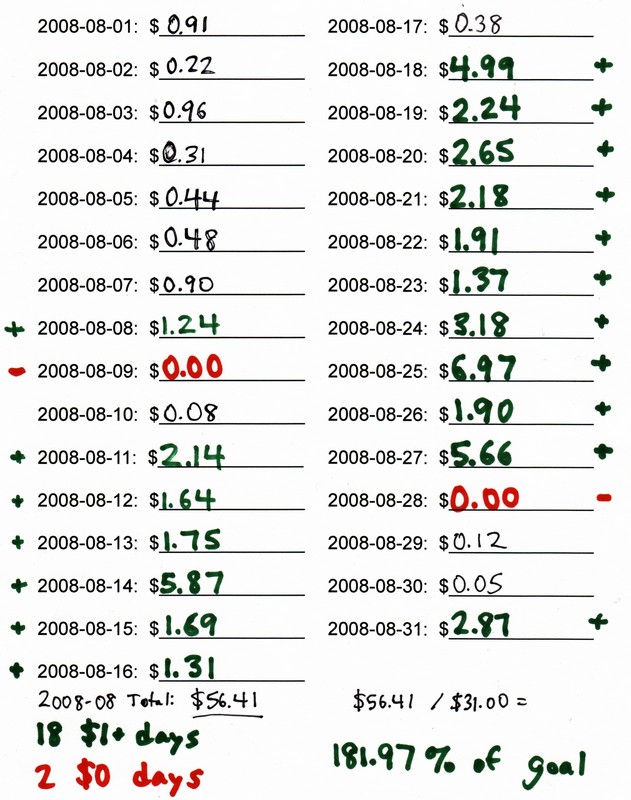
Just wanted to give you a little hint for how my websites did last month. My goal is $1 per day, and while I didn’t hit that every day last month, the overall total was $56.41, or $1.80 per day.

I can see I’m making a bigger impact on the world. In July, I made $20, so my income basically tripled last month. You can’t get that kind of raise with a regular job.

$53.73 was from Google AdSense; $2.68 was from this blog’s Amazon Associates commissions.

Of the $53.73, $1.54 came from Brilliant Photography and Personal Development by Richard X. Thripp. Th8.us made $2.30, DaytonaState.org made $42.63, and the Thripp.com users made me $7.26. Our hosting / domains bill is $15 per month, so I’m more than covered.

DaytonaState.org is targeted. A lot of people come from Google looking for information on enrolling in colleges, so the information appeals to them. On the other hand, Thripp.com is black-listed by Google, so this blog and others appear low in the search results. I haven’t done much marketing either, instead focusing on writing and producing new works of art, so that explains the low turnout. But in the long run, the richardxthripp.thripp.com is where the action is going to be.

If I was still working at the library, I would have made ten times more. But last month, I did no work. Even though I exhausted far more time and energy here, the energy comes back twofold. This simply isn’t a job at all to me.

When you’re doing something you love, it doesn’t matter how much time you “spend” or how much money you make. (You’re not really spending time; you’re saving it.) You’ll do it anyway, because it’s what you do. If you’re looking for something to love, photography is a good place to start, even as a freelancer. I wouldn’t do it myself; I’d prefer writing articles for free and making money indirectly. But every person enjoys different methods.

Also: when you love playing with LEGOs or battling in World of Warcraft, it still doesn’t matter, but the problem is you’re not helping anyone else. You think you’re doing what you love, but you just haven’t found what you truly love. When you combine ambition with a purpose that really makes an impact on people around you, you’ll find something you love far more than child’s play. It’s still play, but it’s play taken to the next level. You character has just reached level 100. He’s replaced hit points with love points.

A Free Nation Has Free Money

The purpose of any good government is to protect the lives and property of the people. Property is money. Money must be solid. It must be free, in that it is independent of the nefarious deeds of plutocrats. It doesn’t matter how much free speech or free love you have. If you have no money, you have no property, and all your “freedoms” are worthless.

The Federal Reserve, masquerading as part of our government, bails out corporations that have gotten themselves far into debt. In theory, this protects the jobs of the people, because the corporation keeps going. How does the Federal Reserve do this? They print lots more money, backed by nothing, and give it to the corporation, making up for billions of accumulated debts. How do corporations like General Motors and Bear Stearns lose so much money? By becoming unprofitable, bureaucratic failures. Companies that should go out of business are propped up by the government. Every time they do this, our currency gets closer to worthless. An invisible tax is placed on the money in your bank, because its value declines progressively.

When you prop up failures, you bring down everyone else. Small businesses that are rightfully profitable get no help, while losers are supported by the public debt. The rich get richer, the poor (us) get poorer, and the middle class disappears as we turn into Soviet Russia.

We continue creating more and more money out of thin air to fund wars in Iraq, Afghanistan, Georgia, Yemen, and more, all for the continual war on “terror.” We have troops in 100 countries, spread all over the world. This is all funded by the continual whoring of our dollar. We give China I.O.U.’s in exchange for billions of dollars in goods. What’s going to happen is that we won’t be able to pay them back, and then they’ll use their U.S. money to buy out our country from under us while our currency and bank accounts become completely useless.

This shouldn’t happen. A $20 bill is a piece of paper, just like a $20 bill from 1900. Only then, the bill was worth the equivalent of $1000 of my dollars. What happened? Our money is fake now. It has no link to gold. Private bankers, as part of the private company that controls our money (the Federal Reserve), can print any amount of money on a whim, devaluing our labor. Not just future labor. All the liquid wealth you’ve accumulated in your bank account shrinks at once. All your hard work over many years is taken away at once. And like saps, we all accept it.

What is the root cause of the financial failure of our businesses? A foreign policy which involves us bombing everything that moves, and terrible taxes which kill all good business. An example: owning a restaurant is one of the worst businesses to be in, because every department of the government gets a piece of you. 80% of your money goes toward government inspections and regulation fees. It’s hard to even cover your expenses, no matter how efficient you are.

When you have a feather-bedded, socialist government, the only businesses that can make it have to government-backed. They pay all these terrible fees, but are subsidized by tax dollars. Without government exemptions, the ordinary businessman can’t afford to start his own corporation. Have you seen what the taxes on a sole proprietorship are like these days?

Instead, we’re all relegated to serfdom working for companies like Wal-Mart. I must admit, Wal-Mart is about the most efficient and prudent company around. But they’re still part of our socialist government. The root cause is our fiat currency, our continual warring, and our meddling with the free market. It’s not a “free” market now. It isn’t a free market when you’re taxed at a rate of 90%. Even if you work under the table, you pay huge taxes. Sales tax is one. The rest is in prices that are three times higher than they should be, because every merchant along the way has to cover his tax burden by raising his prices. The United States is the Roman Empire, Part 2.

People are working harder than ever. It’s only because our wasteful government has completely failed us, just as Great Britain had failed our fore-fathers before their noble revolution. 40 years ago, a man could do good honest work and support his wife, several kids, a car, and a mortgage with money to spare. What happens now? Couples have to take out life-time mortgages and both work 50 hours a week in career jobs, leaving their kids to be raised by strangers. Still, they can barely pay the bills. Are they slacking off? Not in the slightest. The currency traders and international bankers get richer and richer while we slave away as pawns of the state.

Students have to work full-time while attending college just to make ends meet. My family can’t even keep a cool house or travel freely, because of the terrible cost of fuel. This isn’t because we as a people are running out of fuel or pillaging the environment. It’s because our money is becoming worthless. There’s plenty of gas to be had at $3.60 per gallon: there are no shortages. Considering gas was 85¢ a gallon in 2002, my money has lost three-fourths it’s value. Your four years of labor from the 90’s is worth one year of labor in 2008. How does that make you feel?

Our technology and collective intellect keeps getting better, but we keep having to work harder and smarter for ever-smaller gains. If innovation had stood still since the Federal Reserve Act of 1913, we’d be working for two cents a day by now. It’s only the unwavering American spirit of growth and progress that has secured what little we have now. War, fear, fake money, and martial law isn’t American. This is supposed to be the home of the brave, remember?

A free nation starts with a currency backed by gold, and a market backed by the success of its marketeers. Not the government. The government cannot fight wars nor grant rights. Only God can. The government can only protect or usurp your rights. By usurping your labor, the U.S. government is usurping your rights and your livelihood. It has to stop. It will stop when our government falls and our money is worse less than toilet paper. Only then will people see the truth, but all will be lost and we’ll have to start anew. I’m already getting ready.

For now, stay below the radar. We’re losing our freedoms by the minute. The police are not on your side. Don’t get stuck with a heavy mortgage, keep your mouth shut if the IRS calls you, and don’t pay taxes that you don’t have to pay. Don’t join the army, and if you’re turning eighteen, stay off their list. Don’t vote for Obama or McCain because they’re both identical. A vote for Mickey Mouse is better. Don’t keep too much worthless money lying around. Go back to bartering if you have to. And most of all, foster a spirit of peaceful, nonviolent resistance to government oppression, just as Gandhi wanted.