10 Tips for Reference Dialogues

The reference dialogue: books and a question mark

A cornerstone of library work is the reference interview (or interrogation if you’d prefer), as it is the principle persona for the library knowledge-base, and is increasingly the domain of library assistants and para-professionals. These are the ideas I’ve picked up from working in the public library sector.

1. Use the encyclopedias. Many students come in wanting books on obscure subjects. Especially in smaller libraries, there are no books to be found, but an encyclopedia article will do in a pinch, and is an authoratative source.

2. Ask questions. If he asks where the nonfiction section is, don’t just point at it; ask if there is anything in particular he’s looking for. Often there is, but you need to break the ice. If you’re asked for “history books,” don’t ask interrogative questions like “why do you need history books?,” but cooperative ones like “what kind are you looking for?”

3. Quality over quantity. Don’t give the patron a good book on crocheting and then eight unrelated books on knitting; start with one, and then follow up if the resource proves inadequate. Overloading him with information is not much better than doing nothing at all, as it is our job to sift the wheat from the chaff.

4. Leverage Google for the author of a title, the jargon of a field, or even how to spell an elusive word (if the mis-spelling is common, Google will list it with the question, “did you mean?”). This can be useful if you can’t understand your patron’s mumblings; search what it sounds like, and often you’ll get your answer. You can then query your library’s catalog with the details you found online.

5. Keep it simple. When a patron comes in asking how to search jobs or phone numbers online, be sure to put in a good word for the Pennysaver and phone book; they are often the more relevant choice.

6. Be nice. The theory of participation inequality applies to reference requests too. Though we will never have accurate stats, we can assume that 90% of library users who would like to know about something don’t ask, be it because they lack a definite question, feel uncomfortable, or are just quiet in general. Do you want to drive away the 10% that do ask, or make the 90% grow even larger?

7. Take initiative. If that user is staring quizzically at your biographies, or struggling with your public catalog, ask him if there’s anything you can do to help. Often, this will be the catalyst for a question-and-answer discussion that will bring out what he’s looking for.

8. Defer gracefully. For the many patrons who ask genuine questions, there are a few who will bring page-long lists of items for you to find, or expect super-human expertise from you. Offer to find the items or show them how to use the OPAC (“teach them to fish”), but if there’s a line forming, stay firm that their involved requests must wait.

9. Ask for help. If you’re having trouble finding accounts from the Spanish-American War, ask the resident history buff, or go to a reference librarian or the Internet if need be. No librarian is an island.

10. Follow up. Ask if there’s anything else he wants, or if the information you’ve provided works or is off-target. He may be afraid of being a pest, not realizing the core of the library is patron inquiries. By being open to feedback, you make the public welcome and at ease.

When we strive to be genuinely helpful, we are supporting the perpetual education of our citizens, and the library as the heart of the community.

Continued reading:
The Reference Interview by William C. Robinson
Mock Refernce Interviews by Jimmy Ghaphery
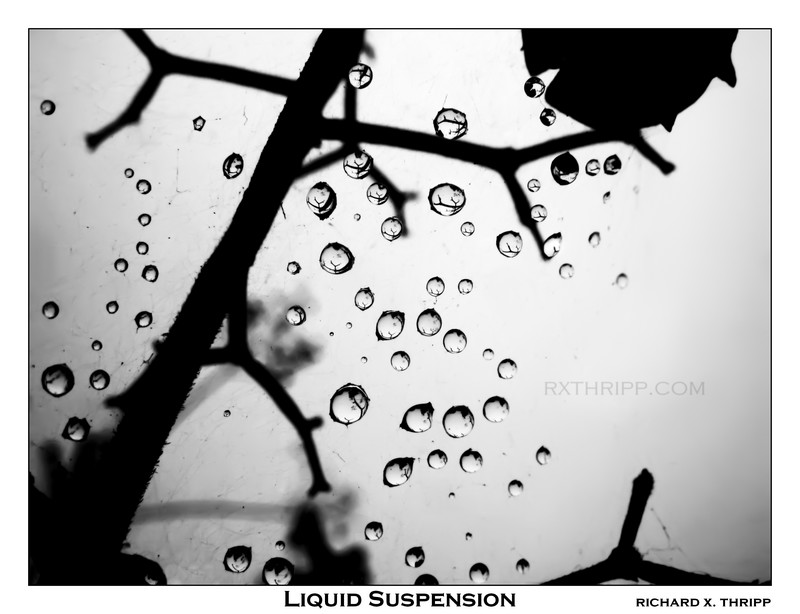
Photo: Liquid Suspension

Liquid Suspension — water droplets floating in a spider's web

Tiny raindrops, levitating in a spiderweb. Most people don’t realize it’s a spider’s web, but if you’re observant, you can figure it out from the stray dirt and threads. I shot this in January 2007 with my old Canon A620 (this is the first release here); I focused as close as it would go (one centimeter) for this, as the drops were really tiny. To increase the depth-of-field, I closed down to F7.1 (the range on the A620 is F2.8-F8). I kept taking photos after this, but disturbed the web mistakenly, causing all the drops to fall. This one, while dull at first, came to life with my editing. The reflections in the drops are my favorite element, each representing a microcosm of the world we know and love.

If you haven’t figured it out, spider webs aren’t pretty. There were pieces of dirt and dead bugs strewn in the web. My purpose as an artistic photographer is to present a realistic ideal of the world, through whatever means necessary. My job was to remove those, both from the web and the droplets’ reflections. I only did this in a couple; in the other droplets, I decided that the reflections pass for branches or leaves above or around the web. I used Adobe Photoshop CS2’s spot healing brush and clone stamp to take out the offending elements, while double checking that there were no smudge marks by making the image much darker using the Levels tool, followed by checking the integrity of the highlights. The last step was to crank the contrast into overdrive (curves), because the scene was really dull to start; it was a dreary, overcast day, after all. It all came together in the post-processing stage.
[quickshop:4*6 Liquid Suspension (lustre):price:0.95:shipping:0.45:shipping2:0.45:end]

Buy a 4*6 copy for $0.95 (USA only). Lustre finish. After adding, go to your shopping cart.

Canon PowerShot A620, 1/320, F7.1, 7.3mm, ISO50, 2007-01-18T13:16:43-05, 2007-01-18_18h16m43

Download the high-res JPEG or download the source image.

This work is licensed under a Creative Commons Attribution 3.0 License. Please credit me as “Photo by Richard Thripp” or something similar.

Photo: Speed

Speed — speeding down a city road at night

This is the second-anniversary edition of Speed, a photo I took from the passenger’s seat of a car in motion. We were moving at 30 miles per hour, but with the one-second exposure, the center is sharp but the edges are blurred. While I posted this on deviantART back in May 2006, I’ve added nice orange text, a border, and a bit more contrast to this revised version. The street is Derbyshire Road in Daytona Beach, Florida.

The Call, an English band, put this photo on the cover of their album, Missing Pieces, from October 2007. I enjoy the songs, and though the band broke up last month (April 2008), they will be forever missed.

The photo-shoot for Speed

As you can see above, I took eight photos to get this one. All the others were blurry (camera shake), but I got the highlighted one just right by bracing the camera against the dashboard, and so it became Speed.

Fujifilm FinePix A360, 1″, F2.81, 5.8mm, ISO100, 2006-05-12T20:33:44-04, 2006-05-12_20h33m44

Download the high-res JPEG or download the source image.

This work is licensed under a Creative Commons Attribution 3.0 License. Please credit me as “Photo by Richard Thripp” or something similar.

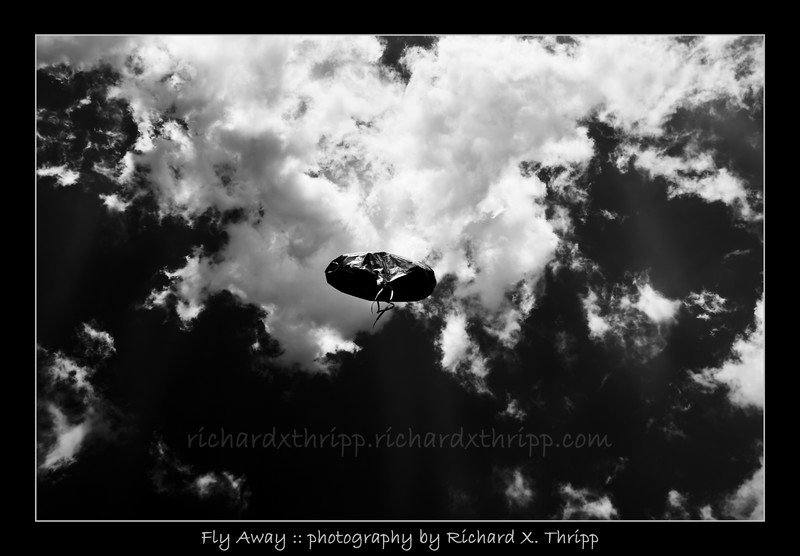
Photo: Fly Away

Fly Away — an escaping balloon against an inviting sky

A helium balloon, escaping into the great blue beyond, in black and white. I got this balloon for my sixteenth birthday (2007-08-17), and by nine days later, it still was trying to get away, so I set it free and photographed it. I’ve given out print copies, but this is the first online publication. I hope you enjoy it.

I switched to black and white, cropped out tree branches that snuck into the frame, and made the sky and balloon almost black with the curves function.

[quickshop:4*6 Fly Away (lustre):price:0.95:shipping:0.45:shipping2:0.45:end]

Buy a 4*6 copy for $0.95 (USA only). Lustre finish. After adding, go to your shopping cart.

Canon Rebel XTi, EFS 18-55mm, 1/100, F16, 18mm, ISO100, 2007-08-26T14:52:54-04, 2007-08-26_18h52m54

Download the high-res JPEG or download the source image.

This work is licensed under a Creative Commons Attribution 3.0 License. Please credit me as “Photo by Richard Thripp” or something similar.

Photo: The Eerie Sunset

The Eerie Sunset — a cold evening sky

When the sun goes down, the monsters come out… This is a creepy looking sunset I saw out front of my house. I helped add to the creepiness with a cool white balance setting and boosting the blue color channel in Photoshop. The grain is there to add character.

Canon Rebel XTi, EFS 18-55mm, 1/50, F3.5, 18mm, ISO800, 2007-08-26T19:53:31-04, 2007-08-26_23h53m31

Download the high-res JPEG or download the source image.

This work is licensed under a Creative Commons Attribution 3.0 License. Please credit me as “Photo by Richard Thripp” or something similar.

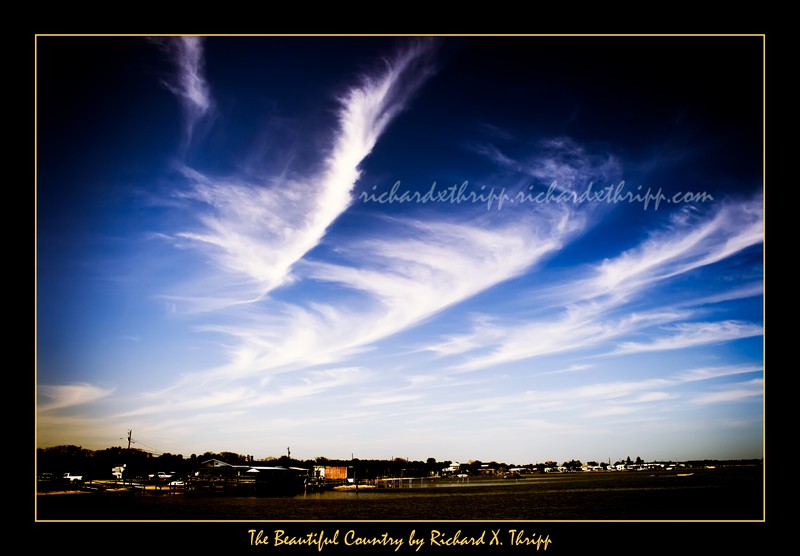
Photo: The Beautiful Country

The Beautiful Country — a cloudy blue sky over a waterfront town

A town near the sea, with a blue sky overhead, filled with clouds and chemical trails. This is at one of the most beautiful locales in Florida; Oak Hill (scroll down), where the white pelicans congregate. This shot is from the peer overlooking Goodrich’s Seafood Restaurant, which you can see at the bottom-left.

After adding contrast, gradating the sky, and darkening the corners, this became The Beautiful Country.
[quickshop:4*6 The Beautiful Country (lustre):price:0.95:shipping:0.45:shipping2:0.45:end]

Buy a 4*6 copy for $0.95 (USA only). Lustre finish. After adding, go to your shopping cart.

Canon Rebel XTi, EFS 18-55mm, 1/400, F8, 18mm, ISO100, 2008-03-05T13:41:17-05, 20080305-184117rxt

Download the high-res JPEG or download the source image.

This work is licensed under a Creative Commons Attribution 3.0 License. Please credit me as “Photo by Richard Thripp” or something similar.

The Freedom Project: Free Art for All

The Freedom Project: Free art for all

I’ve decided, in the interest of promoting photography as an artistic medium and inspiring others with my work, to offer all of my photographic catalog for free. This is limited to twenty 4*6 prints per household, and is valid through 2008-05-31. I’ll cover the shipping (USA only).

You can add prints to your shopping cart; fill out your address and email and I’ll send them to you.

If you’re finding it too hard to choose, click below and I’ll pick for you. You’ll get the ten in the banner, plus ten others I select.

Thank you and enjoy,
Richard

Photo: The Night of Eternal and Unrelenting Darkness

darkness eternal, insurmountable and unchallenged

Every once in a great while, I create a photograph that is so provocative, so controversial in its unorthodox message, that it sends waves of shock around the world. THE NIGHT OF ETERNAL AND UNRELENTING DARKNESS does just that. I woke up at 2 A.M. with this post-modern vision, immediately going to work on the complex issues of subject matter, composition, and lighting before my dream was forever lost. It is only through my hours of toiling that this ground-breaking achievement can be the domain of all humanity. This is the bifurcation point where new splits from old, from which a whole wave of art can emerge, disrupting our predilections and engaging our senses in new and unstable ways. Can the darkness inspire you? Of course it can. The question is, are you willing to let go of what you’ve learned, to accept that which you now believe you cannot accept? If you cannot, you are the same as the lowly rat, who goes through thousands of generations, never challenging, never innovating, never evolving, never thinking. My highest hope is that you can accept and befriend the darkness, for it represents the darkness of life. The darkness which we cannot escape, the darkness which is always there no matter how we struggle to drown it in light. The darkness which represents what we do not know yet attempt to explain—the darkness which we cannot understand and yet fight so bravely to understand. To know, we must know we cannot know. To understand, we must understand we cannot understand. These are the essential principles of this photograph, THE NIGHT OF ETERNAL AND UNRELENTING DARKNESS, and I know I can pass them on to you.

I had to put all my editing skills to use here, but the end result is so worth the days of torment.

Canon Rebel XTi, EF 50mm 1:1.4, 1/4000, F22, 50mm, ISO100, 2008-05-05T02:55:41-04, 20080505-065541rxt

Download the high-res JPEG or download the source image.

This work is licensed under a Creative Commons Attribution 3.0 License. Please credit me as “Photo by Richard Thripp” or something similar.

End of Semester

I’m almost done with the spring 2008 semester! I finished QUANTA yesterday, have my trigonometry final tomorrow (I need a 60 to pass with an A), and my photography presentation Thursday. It’s at Daytona Beach College, Building 530, Room 120, from 5 to 7 P.M. (2008-05-08). I’ll be showing my gelatin silver prints, and some digital work (this stuff).

I’ll be glad to be getting back to digital photography over the summer, though I have pre-calculus to learn for six weeks. I have my most controversial photo ever to post; stay tuned for it tomorrow. :surprised:

New shop with beautiful, framed prints

2008-06-03 Update: The sale is over. Thanks everyone! :big-grin:

sixteen wonderful photos in frames

I’ve printed up and framed sixteen of my favorite photos as 8*10’s. You can buy them in the new, special photography shop for the brilliant price of $49.95 each. :grin: There is only one of each, so hurry! 2008-06-17 Update: gone now.

Speed, and Sunrays 3 are new here. I’ll have a formal release in a couple weeks, but you can check them out by those links now. 2008-06-17 Update: The shop is gone (read Everything Old is New Again), but check out Speed and Sunrays 3 anyway. and Just one week of school left to go, and then I get a week off, and then six weeks of summer pre-calculus. I’ll be presenting my photography portfolio for my black-and-white film class on May 8th at the college (The Gaze, The Rebel, Wine Bottles, and film versions of Modern Architecture and The Stuccoed House will be included). I’ll throw in a few of the new digital prints. :cool: