Implicit-Association Testing: Does it Have a Place at Your Next Job Interview?
Essay by Richard X. Thripp.
2008-02-20 — http://richardxthripp.thripp.com/essays
PDF version (80 KB).
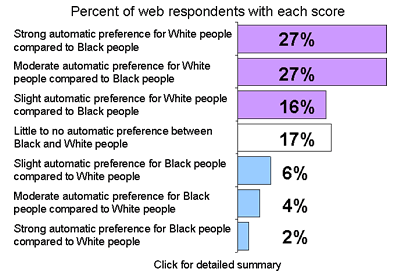
We live in a society of increasing equity of race, yet there is still something missing. A student surmises: “The modern-day racism that we face takes the form of subtle attitudes that tear a person’s self-confidence apart if they are not able to transcend that” (qtd. in Weller 69), showing that subconscious bias is the primary form of racism that is still with us. Seeing our legislative efforts, such as the abolishment of the “separate but equal” laws with the Civil Rights Act of 1964, and policies of affirmative action in university admissions promoting equality through the 2000s, one may think that “racism” has been completely eliminated in modern America—the very word conjures up blatant acts of discrimination, such as whites murdering blacks in crimes of hate. Unfortunately, most of us continue to unintentionally associate whites with good and blacks with bad, as shown in implicit-association testing, first introduced by Project Implicit of Harvard University in 1998, where seventy percent of the 700,000-plus test-takers (“Race Attitude”) have shown a bias for whites, contrasted with twelve percent favoring blacks (“Race Breakdown”).
Implicit-association testing is an experimental method that tries to reveal biases that are not shown in traditional questionnaires. Project Implicit “has attracted an enormous amount of research interest and debate” (Klauer et al. 353), with the test for racial bias being the most prominent. In one section of the website’s race IAT, the phrases “African American or good” and “European American or bad” appear on two sides of a computer screen. Pictures of black faces, white faces, and words such as “glorious” and “horrible” appear one-after-another, with the test-taker instructions being to match up the items to either side. In all instances, correct answers are not as important as “the difference in reaction times . . . [which] is taken as an indicator of the degree of association between concepts” (Steffens 166); a “strong automatic preference for White people compared to Black people” is the most common result, accounting for twenty-seven percent of the online respondents (“Race Breakdown”).
While currently, the test enjoys only academic and educational use, there is a growing movement supporting its practical applications. Shankar Vedantam of washingtonpost.com writes, “some proponents [say] it would be unethical not to use the test to screen officials who make life-and-death decisions about others,” which presumes the test accurately measures prejudiced attitudes, and that such biases empirically correlate to discriminatory behavior. While calling it unethical is notably extreme, if I were a black man, I surely would not want to be assumed guilty when accused of murder, due merely to my skin color, so the proponents’ proposal may be a sound attack against racism. “Might employers use such tests to weed out potential racists?,” Vedantam asks, further alluding to the possibility that people shown to be biased could be excluded, especially from powerful positions, such as those of judges, jurors, and police officers.
In contrast, Jay Dixit, an author for Slate Magazine, raises a significant dilemma: “If a test shows an applicant is biased, but you have no evidence that he has actually discriminated against anyone, would it really be fair not to hire him?” Mahzarin Banaji, one of the test’s creators, too fears its mainstream usage, as it will be assumed “that people who have high implicit bias scores will always behave in a biased way—which is not the case, since the tests don’t predict behavior with 100 percent accuracy” (Dixit). While the subject is both a debate of ethics and of the test’s merit, I believe that in Dixit’s question, it is indeed wrong to withhold a job on the basis of mere discriminatory thoughts, as the person that shows bias in an implicit-association test has not yet done anything wrong. No doubt, if a private or government employee, for example, exhibits prejudiced actions, a black mark is justified, but even if the IAT was perfect, it is undeserving of practical use per se. We would be discriminating against people who harbor underlying (and usually unintentional) biases, which is wrong just as discriminating against minorities is. Furthermore, the researchers “are wary of having the tests used in lawsuits” and “say they want to keep the focus of the tests on public education and research” (Vedantam), showing that even they see the bad side of using the test as a determination of racism.
The test is not perfect, as Klaus Fiedler and Matthias Bluemke of Germany’s University of Heidelberg have found. When they asked 24 volunteers, who had already taken the test, to try to reverse their results, most succeeded, and “for two experienced experts, it was virtually impossible to identify IAT fakers” (19). Melanie Steffans, of the University of Trier, concludes that “the IAT is not immune to faking,” finding that “In our Experiment 2, there were many individuals who were able to fake the IAT,” and that it “cannot easily be detected” (176). If true, such claims undermine the validity of the IAT in practical settings. Dr. Anthony Greenwald, one of the test’s creators, argues against this, stating that “findings reveal that it is difficult to fake IAT performances” such as a study by De-Yeong Kim (University of Washington), which stated that only “participants who were given explicit strategies” succeeded (92), and even then, they could not “speed up responses in the black + pleasant condition” (92), making the cheaters “likely to be identifiable” (93). Fiedler and Bluemke concluded the opposite, finding that “this slowdown was not too obvious against the background of normal performance variation” (19). There is enough conflicting research that the issue is not settled.
However, what the IAT is for sure is an excellent educational tool. Created by researchers from Harvard University, The University of Virginia, and University of Washington, Project Implicit has been praised in Slate Magazine as “an objective measure of bias” (Dixit), though Dixit notes that there “are good reasons to limit the test’s uses.” Howard Brody, a contributer to The Galveston County Daily News, lauds the test as “a lesson, I suggest, for all of us in America,” which it certainly is. As Dixit so interestingly notes, “just taking [the test] may sometimes be enough to convince people they are prejudiced and should try to change.” It would be a good idea to require prospective jurors, job applicants, and anyone in a company’s human resources department to take the test, and then write an essay about how they will not let their implicit thoughts translate into discriminatory treatment towards ethnic minorities, as long as this assignment is not a determining factor for their job. Racist attitudes can only be stopped through education, discussion, and introspection, not fear. Using the IAT to eliminate candidates for jobs makes it into another test that must be “passed,” but the benefit it yields in the fight on racism is slim to nil, as it does not get to the core issue: why does racism persist? Certainly, the perpetuation of ethnic stereotypes in the media contributes, but it is also caused by our refusal to recognize biases in ourselves and talk openly about them. As observed at Tolerance.org, “if people are aware of their hidden biases, they can monitor and attempt to ameliorate hidden attitudes before they are expressed through behavior” (“Hidden Bias: A Primer”). We do not need more fear of speaking inappropriately or being labeled a racist, but honest discussion about how to see and overcome discrimination, and this is just what the implicit-association test fosters.
Works Cited
Brody, Howard. “The racial prejudice that besets medicine.” The Galveston County Daily News. 20 Feb. 2008 <http://news.galvestondailynews.com/story.lasso?tool=print&ewcd=32fe23e7316ad900>.
Dixit, Jay. “Screen Test: Why we should start measuring bias.” Slate Magazine. 20 Feb. 2008
<http://www.slate.com/id/2134921/>.
Fiedler, Klaus, and Matthias Bluemke. “Faking the IAT: Aided and Unaided Response Control on the Implicit Association Tests.” University of Heidelberg. 20 Feb. 2008 <http://knut.psi.uni-heidelberg.de/results/Fiedler_Bluemke_BASP_in_press.pdf>.
Greenwald, Anthony. “Implicit Association Test: Validity Debates.” 20 Feb. 2008
<http://faculty.washington.edu/agg/iat_validity.htm>.
“Hidden Bias: A Primer.” Tolerance.org. The Southern Poverty Law Center. 20 Feb. 2008
<http://www.tolerance.org/hidden_bias/tutorials/04.html>.
Kim, De-Yeong. “Voluntary Controllability of the Implicit Association Test (IAT).” Social Psychology Quarterly 66:1 (2003): 83-96. 20 Feb. 2008 <http://faculty.washington.edu/agg/IATmaterials/PDFs/Kim.SPQ.2003.OCR.pdf>.
Klauer, Karl Christoph, et al. “Process Components of the Implicit Association Test: A Diffusion-Model Analysis.” Journal of Personality and Social Psychology 93.3 (2007): 353-68. Academic Search Premier. 20 Feb. 2008 <http://search.ebscohost.com/>.
“Race Attitude.” Project Implicit. Harvard University. 20 Feb. 2008
<https://implicit.harvard.edu/implicit/demo/background/raceinfo.html>.
“Race Breakdown.” Project Implicit. Harvard University. 20 Feb. 2008
<https://implicit.harvard.edu/implicit/demo/images/racebreakdown.gif>.
Steffans, Melanie. “Is the Implicit Association Test Immune to Faking?” Experimental Psychology 51.3 (2004): 165-79. Friedrich-Schiller-Universität Jena. 20 Feb. 2008
<http://www.uni-jena.de/data/unijena_/faculties/fsv/institut_psychologie/psycho_nf/
Steffens_Is+the+IAT+immune+to+faking+.pdf>.
Vedantam, Shankar. “See No Bias.” washingtonpost.com. 20 Feb. 2008 <http://www.washingtonpost.com/wp-dyn/articles/A27067-2005Jan21.html>.
Weller, James. Prejudice Across America. Jackson: University Press of Mississippi, 2000.