How to Be Happy

My belief is that happiness is a means, not an end. Living for happiness, games, or to avoid conflict is shallow and cowardly. We have an increasingly materialistic society, and that too applies to happiness, because people seek it instead of something greater like service to others, which is a truer path. It’s like focusing on making money rather than providing a valuable service to others (the only persistent way to make a lot of money). Articles like this that say things like “life satisfaction occurs most often when people are engaged in absorbing activities that cause them to forget themselves, lose track of time and stop worrying” perpetuate the myth. Happiness comes from courageous action for the benefit of others, not solitary hobbies like journaling, photography, or music. If those hobbies can be purposed to educate and inspire others, then all the better. If they cannot, then the only value they have is for your personal growth. You can use them to gain the strength to serve others through other means, but the hobbies are just a shell on their own, just as happiness is a shell. A stable job, a house, a car, money, friends, a family, and a ticket to heaven (church lip-service) is misery if it’s all you’ve got and you dedicate your life to maintaining it.

Ultimately, happiness cannot come from your hobbies, spouse, children, family, God, or even service to others. It has to come from within, from strength that you may have built through those means but that has become self-sustaining. Serving others will make you happier, as will engaging hobbies, loving relationships, etc., but only as icing on the cake, the meat of which is your own independence, intelligence, courage, mental resources, consciousness, and authenticity. Sure, you can live without these things. But would you be happy with a cake that is 100% icing? No: it would taste disgusting and make you sick. Materialists live this sickening life every day.

One movie that made me think a lot about the roots of happiness is Star Trek: Generations. In it, Captains Kirk and Picard are trying to stop a man who is going to kill millions of people to get into “the Nexus,” a Utopian realm where you get live forever and have everything you want. The catch is that you have to consciously live knowing that it is all an illusion. Picard gets sucked into it by accident, where he has his dream: a loving family to celebrate Christmas with (he has no family back in the real world). But after ten minutes of screen time he rejects it and leaves, because he wants to live in the real world, no matter what the cost.

When you live for your hobbies, your religion, or your family, you aren’t being real. Being real is the only way to live, which is being intelligent rather than ignorant, and knowing lies and evil so that you can embrace the truth and the good. That’s why God lets us choose good from evil: it would be meaningless if he made the choice for us. Children who live for their video games, their friends, or Hannah Montana may look happy, but they’re in fact quite unhappy. They grow up when they realize how empty and unfulfilled their existence as children was. Or at least, they hopefully grow up. Only 5% ever make the leap. The other 95% spend their lives pursuing childish, mouse-like, fake happiness, and die never finding it. If I can help just one percent of these people, then I’ve done well. If I can grow up myself, I’ve done well.

My mom inspired me to write this.

Investment and Efficiency

Say I have a plain text file of 500 dates formatted as MM/DD/YY and I need to change them to YYYY-MM-DD. There are a couple of options. I can do it all by hand, wearing out the backspace and arrow keys, and opening myself to the possibilities of typos. Or, I can find an automated way to do it. Say I’m slow, and it takes me three hours of fighting to find a good text editor and figure out how to use regular expressions to make the changes all at once. It would’ve been quicker just to do it all by hand. So which method is better?

Obviously, using regular expressions was much more efficient, but the overhead was much higher. There is a comparatively steep learning curve, and it takes a lot more time to figure out and implement than mere manual labor. But it’s an investment, and the investment is all up front rather than being spread over years. Some day I’ll need to do something similar again, and leveraging the experience I gained here will make it that much quicker.

Pursuing efficiency even when the road is bumpier and filled with pitfalls is a hard resolution to make.

Personally, I’d prefer to look for a creative and automated solution to a problem, even if it takes ten times more time and effort than doing it the normal way. The normal way is boring. Being engaged in the mind is always the better choice over being efficient in inefficient processes.

Take my How to give file names to your photos article for example. A pro-progress yet short-sighted person might ask, “Why would you waste time on something so trivial? Just give descriptive file names to your photos like a normal person.” But that’s not the point. The point is to find the better way to do things and follow through, even if the upfront investment is higher. Inventing is always more fun, even if the gains are minimal, for the coolness factor alone. I’d rather be creative but take six hours than to work efficiently but boringly in three.

This website is an example of high efficiency plus high investment. When I post a photo here, all I do is upload a file, link to it, write out a description and some keywords, and possibly a source image, which takes all of ten minutes. Then, an army of automated processes take over to start updating tag pages, category listings, RSS feeds, counters, galleries, posts lists, and more, site-wide and beyond. A URI is created based on my title, automatically (spaces turn to hyphens, etc.). The post counter in my sidebar updates. Three thumbnails with links are dynamically created with links: a small one for the header, a large one for the post, and a medium one for the gallery. The gallery is automated updated and every older photo is pushed back. The small thumbnail appears in the header randomly. The large one pops up right on the screen when you click, and all the code is handled on the server side. Photos pop up at the top of the home page, and at the bottom of the index.

My server automatically mirrors the post to LiveJournal and Facebook, serving as a running backup and giving options to my readers. An RSS feed is updated, and a third party called Feedburner sends out an email for my posts to 150 subscribers each day. Sites I link to are pinged, Google, Yahoo, and others automatically start crawling, and my new post starts popping up around the thripp.com network: on the main page, in the global feed, in the latest posts, and in every site’s sidebar. The local search engine is updated behind the scenes. Three of my other posts are displayed below the new photo through automated keyword matching. A printable, formatted version is created and linked to. The timestamp is saved. Archives by date are created. Social bookmarking links are added. A comments system and accompanying RSS feed pops up. When the second visitor stops by, a static HTML copy and gzipped (compressed) version has been created, and one or the other is automatically served up depending on what my visitor’s browser supports. It’s like magic.

The time investment for all this has been quite large. Despite doing almost no original coding and the extensive open-source community around WordPress MU, it’s taken my hundreds of hours to plan and design everything, to work out compatibility issues between plugins, to experiment, to debug, to get the software to do what I want instead of what it wants to do. I had to get a basic understanding of HTML, CSS, PHP, Apache, MySQL, SEO, etc. just to know where to go. Far harder than plugging away on deviantART. But that is someone else’s website, where they make the profits. You might think the efficient way is to forgo the investment and keep posting there. Then when I get banned on frivolous charges or get fed up with the service, I can move to Flickr or MySpace or SmugMug, confuse all my followers, and start the process anew. But to the leader’s mind, that is obviously the wrong way to go, despite the low barriers to entry.

The literal overhead for all this is very high. I even had to switch hosts recently, because the old one wasn’t cutting it with the weight of the processes. There are hundreds of files and scripts on my server, all handling different pieces of a dyanmic website. This is heavy and slow. But the efficiency outweighs it. It’s not efficiency in terms of computer time (insignificant), but efficiency in terms of human time (very significant). The most efficient way for the server is if I post a static HTML file with some text and one image. But this is no good for me, and it’s no good for my visitors. Computer time is always cheap, but your time is quite important. If a much faster or more complex computer can do what you do, even if it costs five times more, it’s worth it. This is efficiency triumphing over investment.

Efficiency is always the higher road, because it’s human. You don’t see cats coming up with more efficient ways to hunt birds. They spend hundreds of years on the same tried, true, and tired practices. They’re being quite “efficient,” but it’s done in a most uneconomical way, so much so that they may as well be wasting 90% of their time, if they were only using creative solutions in the remaining 10%, like weapons or camouflage or traps.

As an employee, you’ll often be stuck with methods that are battle hardened, but highly inefficient. Perhaps it is the library that has all its employees add bibliographic records by hand, because the administrators are too afraid to change systems. Or it could be the office store that focuses on pushing valueless warranties at the expense of its customers, the government agency that stifles thriftiness by requiring you to meet wasteful spending quotas, or the college that is afraid to shift to digital photography or online classes. Inefficiency is the way of the bureaucracy, just as it’s the way of animals and dull people. It’s easy to take the long, uncreative way; there’s almost no risk of loss because it’s a sure-fire success. That doesn’t make it worthwhile, though, because its accomplishments are meager and unspirited at best. To get somewhere, you have to invest time and money, even if it may yield no benefits.

Some organizations are more daring and better to work for. Google is known for that. But all of them are going to turn blindly against investment occasionally. The only way to avoid it is to work for yourself, and even then, doing the best thing rather than the safe thing is hard. Anything else is being penny wise but dollar foolish. Like my sociology teacher used to say: bureaucracies are hardy and resilient. So are cockroaches (except in that photo). Do you want to be like a cockroach? It isn’t worth it, no matter how much vulnerability you are shielded from.

You can use investing to garner efficiency in many areas of your life. Why buy a pack of cigarettes when you can save by buying the whole carton? If you’re a smoker, you don’t expect to suddenly quit, do you? Why publish your book through an on-demand press that charges $5 a copy, when you can get it for under $1 by doing a run of 5000 up front, and paying all at once? That’s what my Dad did. It’s expensive to start, but is going to save you so much in the long run. Unless you totally fail. My Dad hasn’t been successful. But if you don’t take the risk of committing yourself, you’re all that more likely to avoid success. You’ll be stifling yourself every step along the way, because your subconscious mind wants to prove itself right for not being willing to invest.

Investment is not a panacea; you must use it on things you are very committed to; things which have a chance of succeeding. I wouldn’t say buying $10,000 in lottery tickets is a good thing. But if you’re doing one thing well, you are efficiently losing money. It’s a much more efficient way than heading to the grocery store each week to buy just one lottery ticket. All those wasted trips…You could’ve just thrown away your money all at once and have been done with it! And that is the best choice, but only if you’ll be wasting the money anyway.

High investment narrows your focus. Instead of working willy-nilly, you pick a specific path and work at it incessantly. Being a jack of all trades is great, but gaining cursory knowledge of ten subjects can take as much time as becoming an expert in one. I’m trying to become an expert with my photography, at all costs. I hardly play the piano anymore, because it just wasn’t working out when I wanted to focus my attention elsewhere. I’m invested in being unemployed, because I want to make money off my passion without having to work (my work isn’t work—it’s fun). But if I stay on the fence and refuse to invest time, money, efforts, and resources, I’m guaranteed not to succeed. If I focus too heavily on maintaining dead hobbies rather than building my strength, I’m also squandering efficiency. The path is always changing, and old goals need to be abandoned unfinished to make way for the new. But this in fact is the highest investment of all: investment not for your comfort, but for your growth.

The Return of the Shop

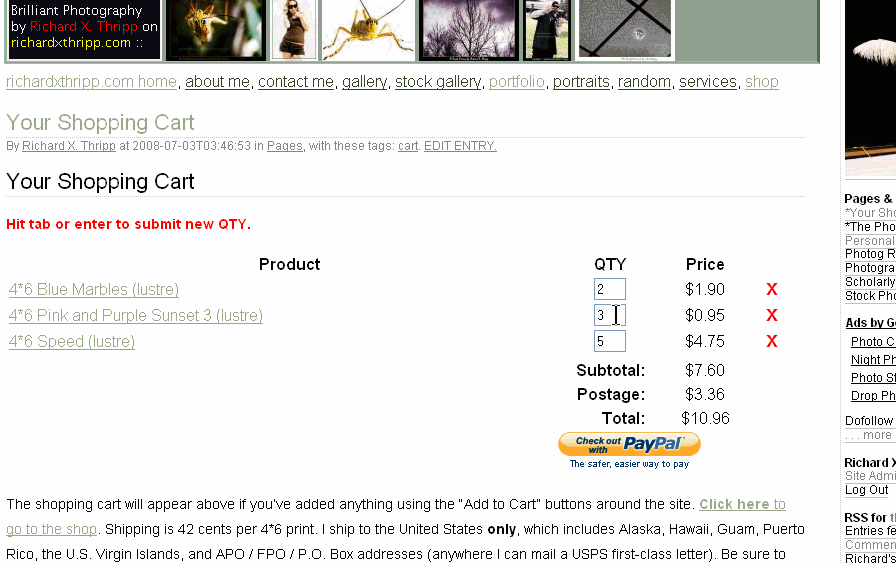
The shop is back. It’s a bit different now. If you can recall from a month ago, I gave up on yak because it doesn’t work with WordPress MU. I found a plugin that does: Quick-Shop. It’s less fancy, but a lot easier to maintain. When you click “Add to Cart” on any page, you get redirected to the shopping cart, with that item added. To go back, press back in your browser (the old-fashioned way). To buy, click the PayPal button; you’ll be redirected to them so you can enter your payment info. Here’s the cart in action:

the shopping cart

You can change quantities; just press enter to update. The red X’s remove items, and more shipping policies and such are below the form.

Since this new software has no database and keeps no inventory or shipping logic, shipping is USA only now. You can email me if you really want some prints and can’t move to my country, though. Also, you can order like 500 of a print, because there’s no stock tracking. If you do this, it’ll take me a week extra to have the copies printed.

I’ve released all of my portfolio in the shop, to start. The price is $0.95 plus $0.42 shipping per print, and the size is 4*6 for them all. I like the new software because I can put multiple items to a post, unlike with yak, and I don’t have to do tedious updating of custom fields; it’s really quick for me to add an Add to Cart button.

Unfortunately, the plugin has security issues. I tried commenting about them on the author’s site, but just got a blank screen. Here is that comment:

I’m liking this plugin a lot and am using it on my site. It’s so basic, yet effective, and the lack of stock control isn’t an issue if you can produce an unlimited quantity of your products, like with mine. My only concern is the lack of security. You can easily fudge the HTML to get a site to display a lower price. For example with your site, putting the code below in a local file and clicking the button in a browser will actually load your site with the item at the reduced price ($5.00 from $359.99).

<p>Budget Intel PC: <strike>$359.99</strike> <strong>$5.00</strong> <object><form method="post" action="http://www.ozedeals.biz/" style="display:inline"><input type="submit" value="Add to Cart" /><input type="hidden" name="product" value="Budget Intel PC" /><input type="hidden" name="price" value="5.00" /><input type="hidden" name="shipping" value="0.99" /><input type="hidden" name="addcart" value="1" /><input type="hidden" name="qslink" value="http://www.ozedeals.biz/" /></form></object></p>

Obviously, if anyone does this, you don’t have to send them the item. It gets tricky if you’re giving them a receipt with the price they’ve forged, though. Might even be troublesome if they just cut the price in half and then complain to PayPal if you refuse to take the loss (they’ll have a PayPal confirmation with the product and lower price).

I’m not too worried about it because I’m dealing with low-value items, but otherwise I would be. Nice work on the plugin, nonetheless.

If you do the above to fake a lower price on my prints, I’m taking it as a donation. Most people are good and will use the shop as intended. :sunglasses: Thanks!

My photos on the HTTP 500 Internal Server error page

I made a custom Internal Server Error page for the Thripp.com network, with all the photos from my portfolio. Error pages are fun again. :smile:

I put a lot of ads there too, so I can monetize the outages. Plus, the links are to the photos on my jpgmag.com gallery, and all the thumbnails are on Photobucket, so the page is light-weight, won’t chew up bandwidth, and makes my photos accessible when the database is down. It’s only 10KB!

I posted this to digg too:

Check out this HTTP 500 page; instead of being rudely interrupted with a cryptic error message and an accusation that you broke the server, on Thripp.com, you’re greeted by beautiful photography (and plenty of ads to boot).

Enjoy. :cool:

Photo: Barbie’s Day Out

Barbie's Day Out — a beheaded doll

I spotted this doll’s head on the top of the grate of a storm drain. Didn’t even have to stage it. Great ideas just find me sometimes. :xx:

Canon PowerShot A620, 1/60, F2.8, 7.3mm, ISO50, 2006-10-06T17:31:41-04, 2006-10-06_17h31m41

Location: Nelson Ave., Ormond Beach, FL  32174

Download the high-res JPEG.

This work is licensed under a Creative Commons Attribution 3.0 License. Please credit me as “Photo by Richard Thripp” or something similar.

Photo: Fatality

Fatality — a dead cockroach

Photo of an American Cockroach, which I found on the floor in our house (we see these pretty often). I hit it a few times with a fly swatter, but then thought to put it on the counter and take a picture of it, with some food and food-related items in the background, plus the fly swatter, to make it more disturbing. On a technicality, he was still alive when I took this photo (moving his legs around a bit), but I didn’t want to hit him anymore so as not to crush him. Luckily he stayed still through the exposure, though you can see in the photo he has one of his legs up. Afterwards he had to be killed, of course. You’d think this’d be distasteful, but it just isn’t for some reason. :sunglasses:
[quickshop:4*6 Fatality (lustre):price:0.95:shipping:0.45:shipping2:0.45:end]

Buy a 4*6 copy for $0.95 (USA only). Lustre finish. After adding, go to your shopping cart.

Fujifilm FinePix A360, 1/5, F2.81, 5.8mm, ISO100, 2006-04-29T23:40:33-04, 2006-04-29_23h40m33

Location: Thripp Residence, Ormond Beach, FL  32174-7227

Download the high-res JPEG or download the source image.

This work is licensed under a Creative Commons Attribution 3.0 License. Please credit me as “Photo by Richard Thripp” or something similar.

Being a Free Photographer

break away

I run into a lot of photography purists, but I don’t believe any of it myself. Photography is nothing but a series of manipulations. You’re manipulating the scene by composing it any differently than a non-photographer. You manipulate the appearance of the scene by zooming in or out. You manipulate your viewers’ outlooks by composing to exclude unsightly objects. Motion blur, shallow depth of field, under or over exposing… these are all creative manipulations on your part. You may not have as much creative control as with painting, but you can still be quite expressive. But creativity isn’t “pure.” If we can define any solid definition for “pure” photography, they’re going to be dull, boring snapshots that no one wants to look at. Don’t do pure photography. Anyone can do pure photography; it takes a real master to do impure photography.

The great thing is, when you embrace impure photography, a whole world of creativity opens to you. Pure photographers are constantly wasting time with ethical debates: is it okay to make the world look purplish in Photoshop, or only through the white balance setting in-camera? Can I crop my photos, or is that misrepresenting the scene? Can I add contrast to a scene that obviously needs it, or do I need to stick to my limiting philosophy? Impure photographers have no such shackles. The “code of ethics” is: do whatever is right to make the photo beautiful. No one cares if you change the white balance. Adding contrast is great. Brightening teeth? Spot-editing blemishes? Sure. It makes people look like they should. It isn’t a question of keeping the image true to the camera sensor; the goal is to produce an image true to the vision in your head. Creative photographs come from people, not computers.

Ironically, as an impure photographer, you’re always making the world look like it’s supposed to. Sunsets are supposed to be beautiful, bright, breath-taking, colorful. Raindrops are supposed to be frozen still, black and white, shiny, and contrasty. And darn it, flowers and people are supposed to be bright and animated with nicely blurred, defocused backgrounds. If you’ve ever debated F1.2 as impure for not showing the world like our eyes see it, you’re really steeped in the dogma. Let it go. You’re on to a grand world of free photography.

In truth, the only way to be a photographer is to be a free photographer. As a creative photographer, your task is to create an idealistic reality that is also a realistic ideal. If that means desaturating backgrounds on roses, removing specks of dirt, and burning in corners, then so be it. If it means adding a glow effect, filters, and sunrays to a sunset, it’s all good. Your tool is your camera, but your real power is your mind. It’s like painting, where you get to pick all the colors for the scene, but without all the heavy lifting. You can create so much more because there’s no need to build everything from scratch. You start out with a solid base (the world), and then you take away or alter the elements that need changing, be it by composition, post-processing, or any other method. As a photographer, you unlock your creative mind and become a more free person, because you’re set free from the grunt work of other artistic mediums and can instead work on the big picture. It’s like moving from assembly code to a high-level programming language.

As a free photographer, you will refuse to support film where digital surpasses it in quality and efficiency. There is no purism; hard work does not contribute to the creative value of a piece. It makes no difference if I took 100 shots of the falling droplets on my digital camera, picked the best, then edited out the ugly bits, rather than wasting 100 expensive frames of film and 15 prints in the darkroom getting my exposure and burning right. Even if I do that with the film, it’s not going to be as good, because I’m not good with film. If you’re not good with film, so what? Use digital then. It’s the wave of the future. The finished product is what counts. If it took you three days in the darkroom or thirty minutes in Photoshop, it makes no difference and each medium is as valid as the other, as long as what you do looks good. Your photos have to be inspiring, beautiful, challenging, creative, and fresh, all at once. That’s what counts.

If you’re in any sort of camera clubs or photography classes, your friends won’t like what I’m writing. They’ll spout some spiel about how photography is a time-honored and labor-intensive craft, and it must remain so. It’s not your job to change or influence the world; you’re just a recorder. If you edit your work, you are cheating your viewers. Your taking away from all the good photographers who put the work in (a.k.a. luck) and create one-tenth the beautiful images because of their fear-based orthodoxy. That’s what you’ll be told. Don’t listen to it. It’s not your friends who are talking. Their true thoughts have been stolen by the prevailing spirit of oppression and negativity. It is not your job to change them. Just go into the world pushing forward with your art, and if you are being a free photographer, other people will take note, because you’ll be producing fantastic work. And they’ll start switching over too. We can start a revolution.

A note on “camera clubs”: don’t join one. I’d never join a camera club. If I want to be with my people, I’ll join a photography club–not a camera club. Just like if I want to read, I’ll join a reading club, not a book club. It’s not so bad with book clubs, though. The unfortunate thing that happens with camera clubs, is that people get caught up in the science of photography and forget about the art. And even then, they’re not focusing on the science so much as their own notions: limit-based notions that keep them from pursuing their art form for want of some technical limitation. But there are no technical limitations. Sure, this is all relative. You can’t do much with a cheap disposable camera, and there are just things our cameras can’t capture, like huge ranges of light or certain shades of purple. But the difference between what our cameras can do, and what the camera club participants pretend they can do is quite vast. If you have a Canon PowerShot A590 or anything like it, you can do anything. Practically anything. In fact, by the time you get near the do anything level, you’ll be four cameras up. It won’t even matter. Start creating your best work now, not ten years from now.

I remember when I started getting serious about my creative photography in 2005, and all I had was a Fujifilm FinePix A360. And there were some things that I just could not take pictures of, or they were really hard to take pictures of. I could never get a good shot of lightning, despite numerous attempts, because I had no control over the ISO speed or shutter speed. With the cheap cameras, many things are automatic-only, like the settings on mine were. I wanted a good shot of falling raindrops, and after much perseverance, I got Raindrops. Unlike with my Canon Rebel XTi and fast lens, the only way to do it with the FinePix A360 was in the bright sunlight, so it had to be raining in the sunshine, but that happened because I kept watching. Then I had the necessary light to freeze the rain in motion.

You’ll run into all sorts of limitations like this in your photography. Perhaps you have the Canon Rebel XTi, and you’re finding the kit lens is too slow for indoor low-light portraits (I did). Or you’re filling up the burst buffer too quickly with your rapid shooting on the football field. The limitations can be anything, but the free photographer’s way is to embrace and work with them, at least till you can afford the expensive gear that attacks them directly. Learn how to be still to avoid camera shake with a bad lens, accept grainier photos with a higher light sensitivity setting, or just take three shots for every one so you’ll be bound to get one right. Switch from RAW to JPEG for quicker burst shooting, or buy a faster memory card to compensate (rather than a faster camera, which is much more expensive). Whatever you do, don’t give up saying that good photography is impossible with your current setup. That’s the coward’s way out.

Free photography, as much as it is about embracing all formats, methods, and editing as equal and valid, it is about not making excuses for anyone but yourself. If you miss the moment when the lightning struck the ground, don’t blame your camera, or your lens, or your lack of a college education. If you can’t produce a beautiful image because your source image needs work and that work isn’t permitted by your oppressive photography religion, don’t accept it as fate. Don’t blame anyone or anything else for shortcomings in your work. Have the courage to accept that anything you’ve failed to do or any photo opportunity you’ve missed is your own fault. The reason you can’t create beautiful photographs isn’t because you never see anything interesting. There are plenty of interesting things in your house, in your yard, and around your neighborhood. Or there are dull things which can become interesting when you shoot them in a new light or from a new angle. The “I never see anything / go anywhere interesting” excuse is your own way to excuse yourself from the guilt of not following your artistic passion. But you can stop it, right now. Instead of saying “there’s nothing interesting,” say “I don’t put enough effort in.” Once you rephrase your thoughts and words to put the keys in your hand, you’ll be on your way to putting more effort in, or making whatever change you need for your art form. It’s the first step. No more excuses.

I’ve used the “I never see anything interesting” excuse myself, once or twice. But if all I’ve written hasn’t appealed to you, I have one more piece of advice. Go somewhere interesting. It’s not that hard. Millions of other people do it every day. Go for a walk, visit the park, climb to the top of some high building. If you’re not seeing interesting subjects, it’s your responsibility to change that. It’s all part of being free and empowered, rather than a slave of fate.

Enjoy your life as a free photographer. You’ve just made a huge step above 99% of the other people in your field. I hope to be with you too.

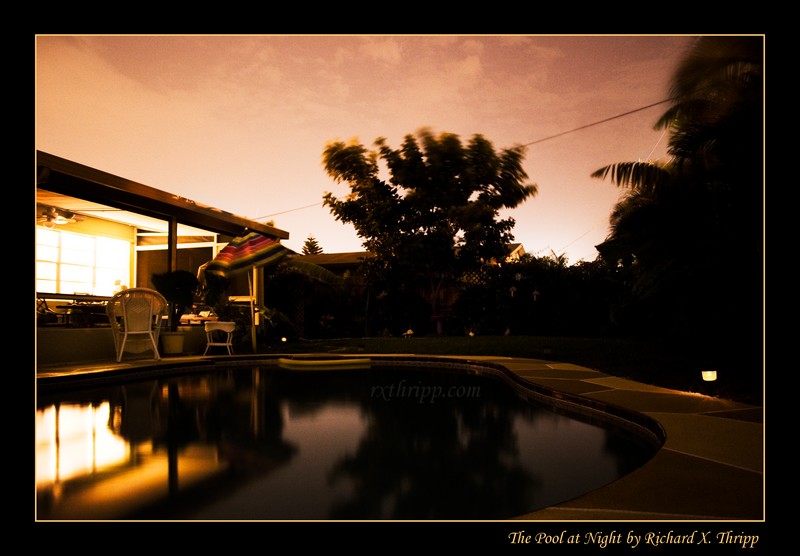
Photo: The Pool at Night

The Pool at Night — light and reflections near the bright house

This is what the pool looks like… at night. Got up at 4 A.M. to shoot this during my vacation; I set the camera on the edge near the pool, dialed in a 30-second exposure, set the timer, and then waited. There were some lights on in the house on the left, which gave nice light. You can see the trees are blurred from the wind, as is the water in the pool. Ready for a swim?

Canon Rebel XTi, EFS 18-55mm, 30″, F3.5, 18mm, ISO800, 2008-06-29T03:50:44-04, 20080629-075044rxt

Download the high-res JPEG or download the source image.

This work is licensed under a Creative Commons Attribution 3.0 License. Please credit me as “Photo by Richard Thripp” or something similar.

Photo: The Florida Lifestyle

The Florida Lifestyle — an orange smoothie in a tropical paradise

I’ve been wondering what the Florida lifestyle I’ve been hearing so much about is, but I’ve found it here. You may not know it, but the Florida lifestyle involves lots of bugs. There were plenty of flies flying around as flies sometimes do, but I shooed them away to snap this shot of an orange smoothie by the pool. I went with a blue border for this photo. Never done that before, but it fits the image so well.

I added contrast, removed specks of dirt from the glass, and touched up the color on the orange slice.

Canon Rebel XTi, EF 50mm 1:1.4, 1/2500, F3.2, 50mm, ISO100, 2008-06-28T14:16:13-04, 20080628-181613rxt

Download the high-res JPEG or download the source image.

This work is licensed under a Creative Commons Attribution 3.0 License. Please credit me as “Photo by Richard Thripp” or something similar.

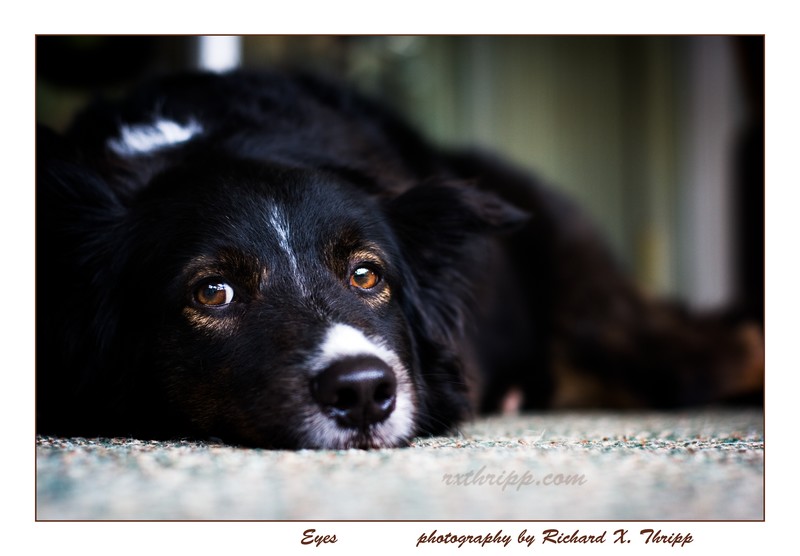
Photo: Eyes

Eyes — a melancholic dog stares at the camera

Through the eyes of a dog. This is my aunt’s dog named Joseph; I set the camera on the carpet and snapped this of him staring at it. I was lucky to get his eyes in focus. He looks sad and thoughtful.

I edited some dirt away from his eyes, darkened the corners, and added contrast.

Canon Rebel XTi, EF 50mm 1:1.4, 1/25, F2.5, 50mm, ISO400, 2008-06-26T15:37:03-04, 20080626-193703rxt

Download the high-res JPEG or download the source image.

This work is licensed under a Creative Commons Attribution 3.0 License. Please credit me as “Photo by Richard Thripp” or something similar.