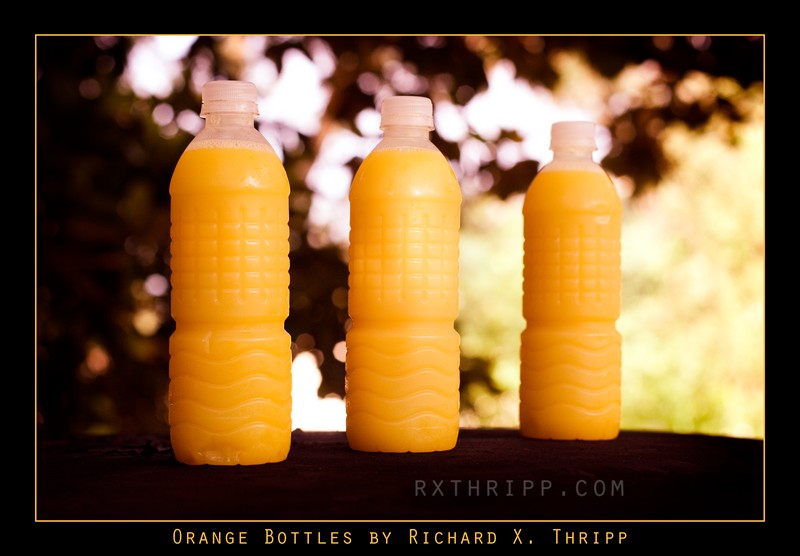
Three bottles of orange juice, lined up on the roof of a black car, with shaded trees (left) and sunny trees (right) in the background.
This was store-bought orange juice I dispersed into water bottles. Then I removed the labels from the water bottles.
I like this composition… the colors, shapes of the bottles, lighting, and spacing came together that day. I made the colors warmer in Photoshop, brightened the bottles, darkened the edges. It’s a lot more idealistic.
The bokeh highlights in the background are eight-sided because my 50mm lens has eight uncurved aperture blades. If I shot this at F1.4 you wouldn’t see them at all because the blades wouldn’t be used, but then the depth of field would be much too shallow. The second and third bottles would look like big orange blobs with little distinct shape at F1.4.
This photo is ironic, because it seems like something completely natural, but in fact is man-made. Plastic bottles don’t occur without us. Orange juice doesn’t become collected itself. This orange juice, like all orange juice sold at the supermarket, is watered down—if you squeeze real oranges you’ll get more potent, sweeter juice that is orange, not yellow. Most people don’t put orange juice in bottles, either.
Whose to say we’re unnatural, though? Only us.
Canon Rebel XTi, EF 50mm 1:1.4, 1/200, F4, 50mm, ISO200, 2008-09-23T17:42:22-04, 20080923-214222rxt
Location: 1985 S. Carpenter Ave., Orange City, FL 32763-7334
Download the high-res JPEG or download the source image.

This work is licensed under a Creative Commons Attribution 3.0 License. Please credit me as “Photo by Richard Thripp” or something similar.